16. The Era of Reconstruction, 1865–1877
The Collapse of Reconstruction
The effort to remake the South generated a brutal reaction among southern whites, who were committed to keeping blacks in a subservient position. To prevent blacks from gaining economic ground and to maintain cheap labor for the agricultural economy, an exploitative system of sharecroppingA postwar southern farm-labor system in which freed people rented land -- often on the same plantations where they had been enslaved -- and paid landlords with a share of the crop they grew. spread throughout the South. Domestic terror organizations, most notably the Ku Klux Klan, employed various methods (arson, whipping, murder) to keep freed people from voting and achieving political, social, or economic equality with whites.
BUILDING BLACK COMMUNITIES#
The degraded status of black men and women had placed them outside the limits of what antebellum southern whites considered appropriate gender roles and familial hierarchies. Slave marriages did not enjoy legal recognition. Enslaved men were humiliated and deprived of authority and of the ability to protect enslaved women, who were frequently exposed to the brutality and sexual domination of white masters and vigilantes alike. Slave parents could not protect their children, who could be bought, sold, put to work, brutally disciplined, and abused without their consent; parents, too, could be sold away from their children (Figure 16.12). Moreover, the division of labor idealized in white southern society, in which men worked the land and women performed the role of domestic caretaker, was null and void where slaves were concerned. Both slave men and women were made to perform hard labor in the fields.
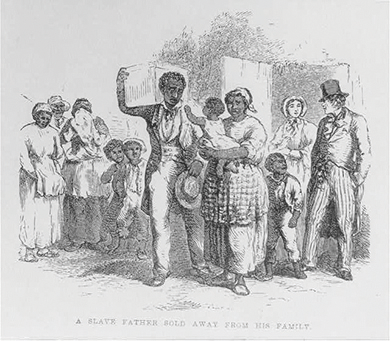
In the Reconstruction era, African Americans embraced the right to enjoy the family bonds and the expression of gender norms they had been systematically denied. Many thousands of freed black men who had been separated from their families as slaves took to the road to find their long-lost spouses and children and renew their bonds. In one instance, a journalist reported having interviewed a freed slave who traveled over six hundred miles on foot in search of the family that was taken from him while in bondage. Couples that had been spared separation quickly set out to legalize their marriages, often by way of the Freedmen’s Bureau, now that this option was available. Those who had no families would sometimes relocate to southern towns and cities, so as to be part of the larger black community where churches and other mutual aid societies offered help and camaraderie.
THE “INVISIBLE EMPIRE OF THE SOUTH”#
Paramilitary white-supremacist terror organizations in the South helped bring about the collapse of Reconstruction, using violence as their primary weapon. The “Invisible Empire of the South,” or Ku Klux Klan, stands as the most notorious. The Klan was founded in 1866 as an oath-bound fraternal order of Confederate veterans in Tennessee, with former Confederate General Nathan Bedford Forrest as its first leader. The organization—its name likely derived from kuklos, a Greek word meaning circle—devised elaborate rituals and grandiose names for its ranking members: Grand Wizard, Grand Dragon, Grand Titan, and Grand Cyclops. Soon, however, this fraternal organization evolved into a vigilante terrorist group that vented southern whites’ collective frustration over the loss of the war and the course of Radical Reconstruction through acts of intimidation and violence.
The Klan terrorized newly freed blacks to deter them from exercising their citizenship rights and freedoms. Other anti-black vigilante groups around the South began to adopt the Klan name and perpetrate acts of unspeakable violence against anyone they considered a tool of Reconstruction. Indeed, as historians have noted, Klan units around the South operated autonomously and with a variety of motives. Some may have sincerely believed they were righting wrongs, others merely satisfying their lurid desires for violence. Nor was the Klan the only racist vigilante organization. Other groups, like the Red Shirts from Mississippi and the Knights of the White Camelia and the White League, both from Louisiana, also sprang up at this time. The Klan and similar organizations also worked as an extension of the Democratic Party to win elections.
Despite the great variety in Klan membership, on the whole, the group tended to direct its attention toward persecuting freed people and people they considered carpetbaggersA term of abuse for northerners accused of moving south during Reconstruction to profit from political power at former Confederates' expense., a term of abuse applied to northerners accused of having come to the South to acquire wealth through political power at the expense of southerners. The colorful term captured the disdain of southerners for these people, reflecting the common assumption that these men, sensing great opportunity, packed up all their worldly possessions in carpetbags, a then-popular type of luggage, and made their way to the South. Implied in this definition is the notion that these men came from little and were thus shiftless wanderers motivated only by the desire for quick money. In reality, these northerners tended to be young, idealistic, often well-educated men who responded to northern campaigns urging them to lead the modernization of the South. But the image of them as swindlers taking advantage of the South at its time of need resonated with a white southern population aggrieved by loss and economic decline. Southern whites who supported Reconstruction, known as scalawagsA pejorative term for white southerners who supported Reconstruction and cooperated with Republican state governments, viewed by other white southerners as traitors., also generated great hostility as traitors to the South. They, too, became targets of the Klan and similar groups.
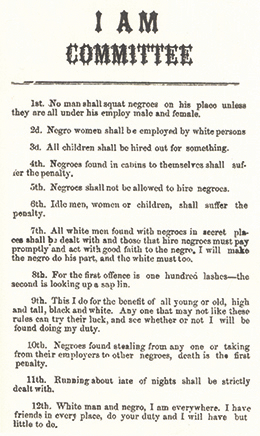
The Klan seized on the pervasive but largely fictional narrative of the northern carpetbagger as a powerful tool for restoring white supremacy and overturning Republican state governments in the South (Figure 16.13). To preserve a white-dominated society, Klan members punished blacks for attempting to improve their station in life or acting “uppity.” To prevent freed people from attaining an education, the Klan burned public schools. In an effort to stop blacks from voting, the Klan murdered, whipped, and otherwise intimidated freed people and their white supporters. It wasn’t uncommon for Klan members to intimidate Union League members and Freedmen’s Bureau workers. The Klan even perpetrated acts of political assassination, killing a sitting U.S. congressman from Arkansas and three state congressmen from South Carolina.
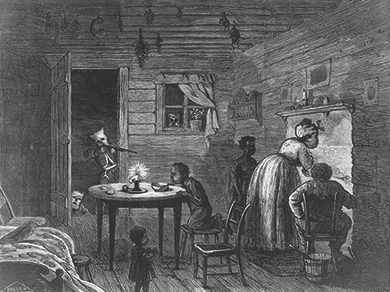
Klan tactics included riding out to victims’ houses, masked and armed, and firing into the homes or burning them down (Figure 16.14). Other tactics relied more on the threat of violence, such as happened in Mississippi when fifty masked Klansmen rode out to a local schoolteacher’s house to express their displeasure with the school tax and to suggest that she consider leaving. Still other tactics intimidated through imaginative trickery. One such method was to dress up as ghosts of slain Confederate soldiers and stage stunts designed to convince their victims of their supernatural abilities.
Regardless of the method, the general goal of reinstating white supremacy as a foundational principle and returning the South to a situation that largely resembled antebellum conditions remained a constant. The Klan used its power to eliminate black economic independence, decimate blacks’ political rights, reclaim white dominance over black women’s bodies and black men’s masculinity, tear apart black communities, and return blacks to earlier patterns of economic and political subservience and social deference. In this, they were largely successful.
The president and Congress, however, were not indifferent to the violence, and they worked to bring it to an end. In 1870, at the insistence of the governor of North Carolina, President Grant told Congress to investigate the Klan. In response, Congress in 1871 created the Joint Select Committee to Inquire into the Condition of Affairs in the Late Insurrectionary States. The committee took testimony from freed people in the South, and in 1872, it published a thirteen-volume report on the tactics the Klan used to derail democracy in the South through the use of violence.
Congress also passed a series of three laws designed to stamp out the Klan. Passed in 1870 and 1871, the Enforcement Acts or “Force Acts” were designed to outlaw intimidation at the polls and to give the federal government the power to prosecute crimes against freed people in federal rather than state courts. Congress believed that this last step, a provision in the third Enforcement Act, also called the Ku Klux Klan Act, was necessary in order to ensure that trials would not be decided by white juries in southern states friendly to the Klan. The act also allowed the president to impose martial law in areas controlled by the Klan and gave President Grant the power to suspend the writ of habeas corpus, a continuation of the wartime power granted to President Lincoln. The suspension meant individuals suspected of engaging in Klan activity could be jailed indefinitely.
President Grant made frequent use of the powers granted to him by Congress, especially in South Carolina, where federal troops imposed martial law in nine counties in an effort to derail Klan activities. However, the federal government faced entrenched local organizations and a white population firmly opposed to Radical Reconstruction. Changes came slowly or not at all, and disillusionment set in. After 1872, federal government efforts to put down paramilitary terror in the South waned.
“REDEEMERS” AND THE END OF RECONSTRUCTION#
While the president and Congress may have seen the Klan and other clandestine white supremacist, terrorist organizations as a threat to stability and progress in the South, many southern whites saw them as an instrument of order in a world turned upside down. Many white southerners felt humiliated by the process of Radical Reconstruction and the way Republicans had upended southern society, placing blacks in positions of authority while taxing large landowners to pay for the education of former slaves. Those committed to rolling back the tide of Radical Reconstruction in the South called themselves redeemersSouthern Democrats committed to overturning Radical Reconstruction and restoring white political control, who succeeded across the South by 1877., a label that expressed their desire to redeem their states from northern control and to restore the antebellum social order whereby blacks were kept safely under the boot heel of whites. They represented the Democratic Party in the South and worked tirelessly to end what they saw as an era of “negro misrule.” By 1877, they had succeeded in bringing about the “redemption” of the South, effectively destroying the dream of Radical Reconstruction.
Although Ulysses S. Grant won a second term in the presidential election of 1872, the Republican grip on national political power began to slip in the early 1870s. Three major events undermined Republican control. First, in 1873, the United States experienced the start of a long economic downturn, the result of economic instability in Europe that spread to the United States. In the fall of 1873, the bank of Jay Cooke & Company failed to meet its financial obligations and went bankrupt, setting off a panic in American financial markets. An economic depression ensued, which Democrats blamed on Republicans and which lasted much of the decade.
Second, the Republican Party experienced internal squabbles and divided into two factions. Some Republicans began to question the expansive role of the federal government, arguing for limiting the size and scope of federal initiatives. These advocates, known as Liberal Republicans because they followed classical liberalism in championing small government, formed their own breakaway party. Their ideas changed the nature of the debate over Reconstruction by challenging reliance on federal government help to bring about change in the South. Now some Republicans argued for downsizing Reconstruction efforts.
Third, the Grant administration became mired in scandals, further tarnishing the Republicans while giving Democrats the upper hand. One scandal arose over the siphoning off of money from excise taxes on whiskey. The “Whiskey Ring,” as it was called, involved people at the highest levels of the Grant administration, including the president’s personal secretary, Orville Babcock. Another scandal entangled Crédit Mobilier of America, a construction company and part of the important French Crédit Mobilier banking company. The Union Pacific Railroad company, created by the federal government during the Civil War to construct a transcontinental railroad, paid Crédit Mobilier to build the railroad. However, Crédit Mobilier used the funds it received to buy Union Pacific Railroad bonds and resell them at a huge profit. Some members of Congress, as well as Vice President Schuyler Colfax, had accepted funds from Crédit Mobilier in return for forestalling an inquiry. When the scam became known in 1872, Democratic opponents of Reconstruction pointed to Crédit Mobilier as an example of corruption in the Republican-dominated federal government and evidence that smaller government was better.
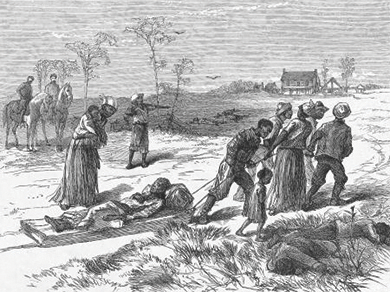
The Democratic Party in the South made significant advances in the 1870s in its efforts to wrest political control from the Republican-dominated state governments. The Ku Klux Klan, as well as other paramilitary groups in the South, often operated as military wings of the Democratic Party in former Confederate states. In one notorious episode following a contested 1872 gubernatorial election in Louisiana, as many as 150 freedmen loyal to the Republican Party were killed at the Colfax courthouse by armed members of the Democratic Party, even as many of them tried to surrender (Figure 16.15).
In other areas of the South, the Democratic Party gained control over state politics. Texas came under Democratic control by 1873, and in the following year Alabama and Arkansas followed suit. In national politics, too, the Democrats gained ground—especially during the 1874 elections, when they recaptured control of the House of Representatives for the first time since before the Civil War. Every other southern state, with the exception of Florida, South Carolina, and Louisiana—the states where federal troops remained a force—also fell to the Democratic Party and the restoration of white supremacy. Southerners everywhere celebrated their “redemption” from Radical Republican rule.
THE CONTESTED ELECTION OF 1876#
By the time of the 1876 presidential election, Reconstruction had come to an end in most southern states. In Congress, the political power of the Radical Republicans had waned, although some continued their efforts to realize the dream of equality between blacks and whites. One of the last attempts to do so was the passage of the 1875 Civil Rights Act, which required equality in public places and on juries. This law was challenged in court, and in 1883 the Supreme Court ruled it unconstitutional, arguing that the Thirteenth and Fourteenth Amendments did not prohibit discrimination by private individuals. By the 1870s, the Supreme Court had also undercut the letter and the spirit of the Fourteenth Amendment by interpreting it as affording freed people only limited federal protection from the Klan and other terror groups.
The country remained bitterly divided, and this was reflected in the contested election of 1876. While Grant wanted to run for a third term, scandals and Democratic successes in the South dashed those hopes. Republicans instead selected Rutherford B. Hayes, the three-time governor of Ohio. Democrats nominated Samuel Tilden, the reform governor of New York, who was instrumental in ending the Tweed Ring and Tammany Hall corruption in New York City. The November election produced an apparent Democratic victory, as Tilden carried the South and large northern states with a 300,000-vote advantage in the popular vote. However, disputed returns from Louisiana, South Carolina, Florida, and Oregon, whose electoral votes totaled twenty, threw the election into doubt.
Hayes could still win if he gained those twenty electoral votes. As the Constitution did not provide a method to determine the validity of disputed votes, the decision fell to Congress, where Republicans controlled the Senate and Democrats controlled the House of Representatives. In late January 1877, Congress tried to break the deadlock by creating a special electoral commission composed of five senators, five representatives, and five justices of the Supreme Court. The congressional delegation represented both parties equally, with five Democrats and five Republicans. The court delegation had two Democrats, two Republicans, and one independent—David Davis, who resigned from the Supreme Court (and from the commission) when the Illinois legislature elected him to the Senate. After Davis’s resignation, President Grant selected a Republican to take his place, tipping the scales in favor of Hayes. The commission then awarded the disputed electoral votes and the presidency to Hayes, voting on party lines, 8 to 7 (Figure 16.16). The Democrats called foul, threatening to hold up the commission’s decision in the courts.
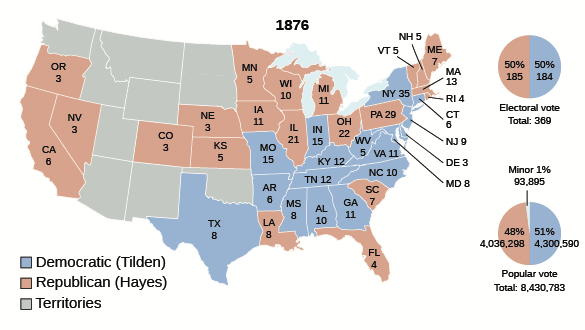
In what became known as the Compromise of 1877The informal 1877 agreement that awarded Rutherford B. Hayes the contested 1876 presidential election in exchange for the withdrawal of federal troops from the South, effectively ending Reconstruction., Republican Senate leaders worked with the Democratic leadership so they would support Hayes and the commission’s decision. The two sides agreed that one Southern Democrat would be appointed to Hayes’s cabinet, Democrats would control federal patronage (the awarding of government jobs) in their areas in the South, and there would be a commitment to generous internal improvements, including federal aid for the Texas and Pacific Railway. Perhaps most important, all remaining federal troops would be withdrawn from the South, a move that effectively ended Reconstruction. Hayes believed that southern leaders would obey and enforce the Reconstruction-era constitutional amendments that protected the rights of freed people. His trust was soon proved to be misguided, much to his dismay, and he devoted a large part of his life to securing rights for freedmen. For their part, the Democrats took over the remaining southern states, creating what became known as the “Solid South”—a region that consistently voted in a bloc for the Democratic Party.