United States History · Chapter 3
3. Creating New Social Orders: Colonial Societies, 1500–1700
The chapter discusses the emergence of colonial societies in the Americas from 1500 to 1700, highlighting the interactions between Native Americans, Europeans, and Africans. It covers Spanish exploration and settlement, including the encomienda system and the establishment of St. Augustine and Santa Fe, as well as the dynamics of Dutch and French colonies focused on fur trading. The English settlements, particularly in Virginia and New England, are examined, emphasizing the economic reliance on tobacco and the transition from indentured servitude to racial slavery following Bacon's Rebellion. The impact of colonization on native populations, including warfare, disease, and environmental changes, is also addressed, illustrating the profound transformations brought by European settlement.
Learning Objectives
By the end of this chapter, you will be able to:
- Identify the main Spanish American colonial settlements of the 1500s and 1600s
- Discuss economic, political, and demographic similarities and differences between the Spanish colonies
- Compare and contrast the development and character of the French and Dutch colonies in North America
- Discuss the economies of the French and Dutch colonies in North America
- Identify the first English settlements in America
- Describe the differences between the Chesapeake Bay colonies and the New England colonies
- Compare and contrast the wars between native inhabitants and English colonists in both the Chesapeake Bay and New England colonies
- Explain the role of Bacon’s Rebellion in the rise of chattel slavery in Virginia
- Explain the reasons for the rise of slavery in the American colonies
- Describe changes to Indian life, including warfare and hunting
- Contrast European and Indian views on property
- Assess the impact of European settlement on the environment
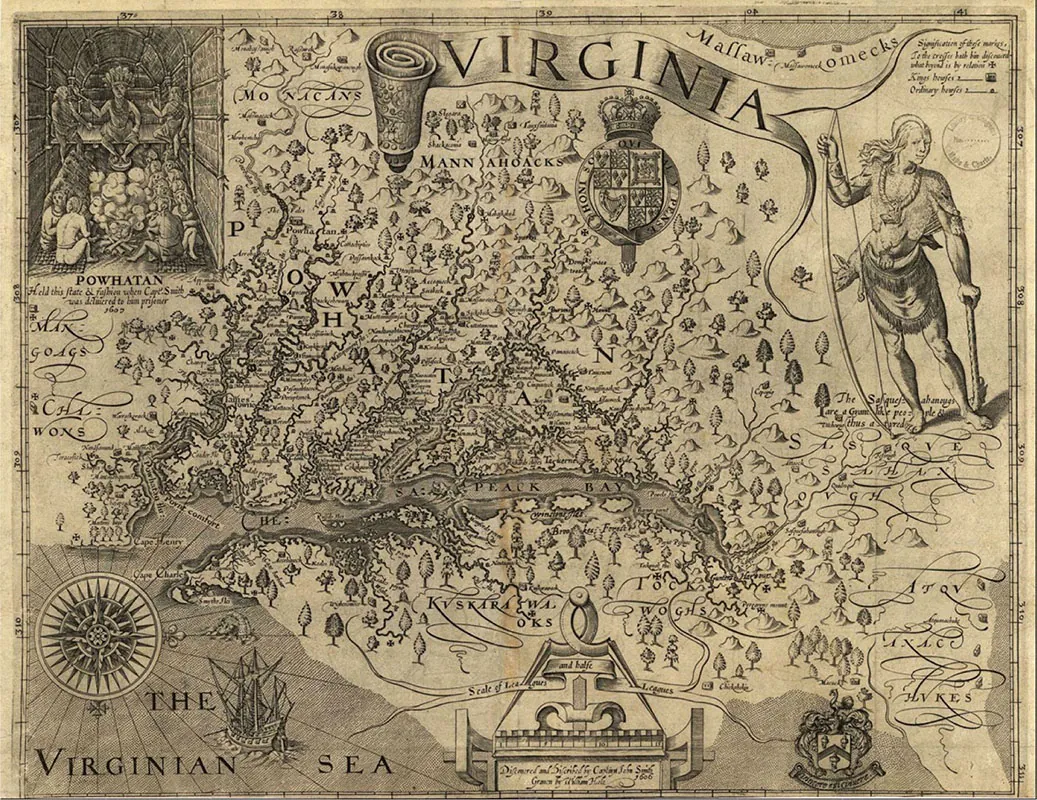
Figure 3.1 John Smith’s famous map of Virginia (1622) illustrates many geopolitical features of early colonization. In the upper left, Powhatan, who governed a powerful local confederation of Algonquian communities, sits above other local chiefs, denoting his authority. Another native figure, Susquehannock, who appears in the upper right, visually reinforces the message that the English did not control the land beyond a few outposts along the Chesapeake.
By the mid-seventeenth century, the geopolitical map of North America had become a patchwork of imperial designs and ambitions as the Spanish, Dutch, French, and English reinforced their claims to parts of the land. Uneasiness, punctuated by violent clashes, prevailed in the border zones between the Europeans’ territorial claims. Meanwhile, still-powerful native peoples waged war to drive the invaders from the continent. In the Chesapeake Bay and New England colonies, conflicts erupted as the English pushed against their native neighbors (Figure 3.1).
The rise of colonial societies in the Americas brought Native Americans, Africans, and Europeans together for the first time, highlighting the radical social, cultural, and religious differences that hampered their ability to understand each other. European settlement affected every aspect of the land and its people, bringing goods, ideas, and diseases that transformed the Americas. Reciprocally, Native American practices, such as the use of tobacco, profoundly altered European habits and tastes.