Learning Objectives
By the end of this chapter, you will be able to:
- Explain the evolution of American views about westward migration in the mid-nineteenth century
- Analyze the ways in which the federal government facilitated Americans’ westward migration in the mid-nineteenth century
- Identify the challenges that farmers faced as they settled west of the Mississippi River
- Describe the unique experiences of women who participated in westward migration
- Identify the major discoveries and developments in western gold, silver, and copper mining in the mid-nineteenth century
- Explain why the cattle industry was paramount to the development of the West and how it became the catalyst for violent range wars
- Describe the methods that the U.S. government used to address the “Indian threat” during the settlement of the West
- Explain the process of “Americanization” as it applied to Indians in the nineteenth century
- Describe the treatment of Chinese immigrants and Hispanic citizens during the westward expansion of the nineteenth century
Introduction#
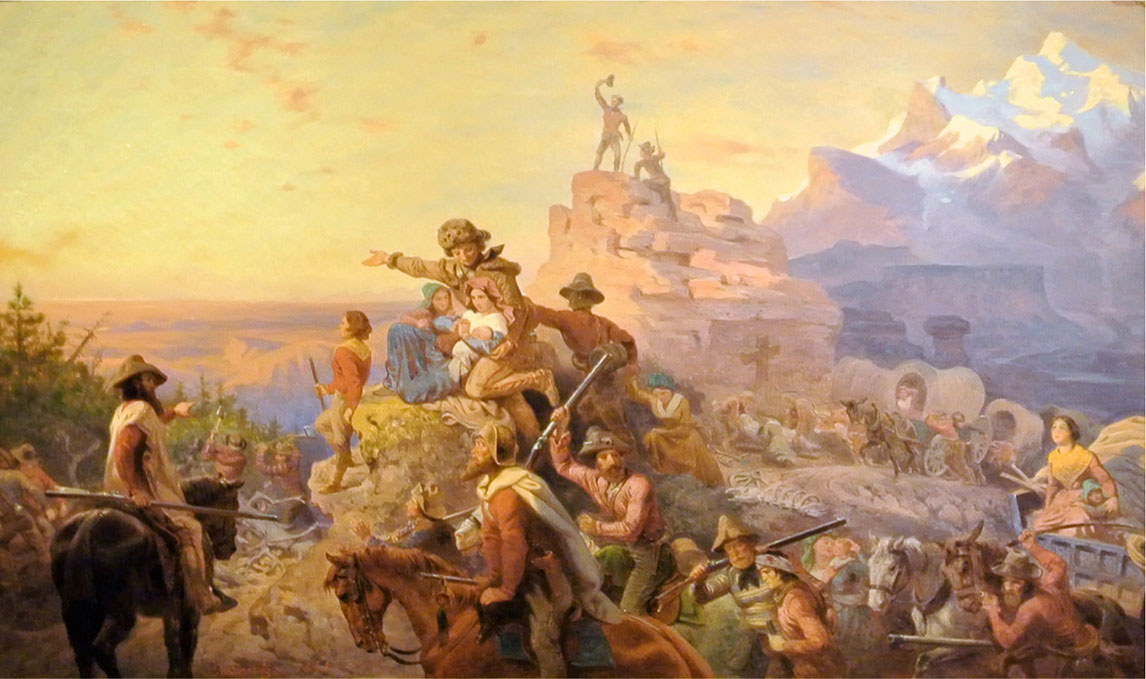
📌 Figure 17.1* A widely held belief in the nineteenth century contended that Americans had a divine right and responsibility to settle the West with Protestant democratic values. Newspaper editor Horace Greely, who coined the phrase “Go west, young man,” encouraged Americans to fulfill this dream. Artists of the day depicted this western expansion in idealized landscapes that bore little resemblance to the difficulties of life on the trail.*
In the middle of the nineteenth century, farmers in the “Old West”—the land across the Allegheny Mountains in Pennsylvania—began to hear about the opportunities to be found in the “New West.” They had long believed that the land west of the Mississippi was a great desert, unfit for human habitation. But now, the federal government was encouraging them to join the migratory stream westward to this unknown land. For a variety of reasons, Americans increasingly felt compelled to fulfill their “ The 19th-century doctrine that the expansion of the United States across the American continents was both justified and inevitable. Rooted in the 1840s, Manifest Destiny became a rallying cry for expansionists and was used to justify the annexation of Texas, the Oregon Trail, and the Mexican-AmericaManifest Destiny
With great trepidation, hundreds, and then hundreds of thousands, of settlers packed their lives into wagons and set out, following the Oregon, California, and Santa Fe Trails, to seek a new life in the West. Some sought open lands and greater freedom to fulfill the democratic vision originally promoted by Thomas Jefferson and experienced by their ancestors. Others saw Economic incentives were central to westward migration, attracting settlers, immigrants, and entrepreneurs.economic opportunity
✪ 17.1 The Westward Spirit#

📌 Figure 17.2 (credit “barbed wire”: modification of work by the U.S. Department of Commerce)
While a small number of settlers had pushed westward before the mid-nineteenth century, the land west of the Mississippi was largely unexplored. Most Americans, if they thought of it at all, viewed this territory as an arid wasteland suitable only for Indians whom the federal government had displaced from eastern lands in previous generations. The reflections of early explorers who conducted scientific treks throughout the West tended to confirm this belief. Major Stephen Harriman Long, who commanded an expedition through Missouri and into the Yellowstone region in 1819–1820, frequently described the Great Plains as a arid and useless region, suitable as nothing more than a “great American desert.” But, beginning in the 1840s, a combination of economic opportunity and ideological encouragement changed the way Americans thought of the West. The federal government offered a number of incentives, making it viable for Americans to take on the challenge of seizing these rough lands from others and subsequently taming them. Still, most Americans who went west needed some financial security at the outset of their journey; even with government aid, the truly poor could not make the trip. The cost of moving an entire family westward, combined with the risks as well as the questionable chances of success, made the move prohibitive for most. While the economic Panic of 1837 led many to question the promise of urban America, and thus turn their focus to the promise of commercial farming in the West, the Panic also resulted in many lacking the financial resources to make such a commitment. For most, the dream to “Go west, young man” remained unfulfilled.
While much of the basis for westward expansion was economic, there was also a more philosophical reason, which was bound up in the American belief that the country—and the “heathens” who populated it—was destined to come under the civilizing rule of Euro-American settlers and their superior technology, most notably railroads and the telegraph. While the extent to which that belief was a heartfelt motivation held by most Americans, or simply a rationalization of the conquests that followed, remains debatable, the clashes—both physical and cultural—that followed this western migration left scars on the country that are still felt today.
MANIFEST DESTINY#
The concept of Manifest Destiny found its roots in the long-standing traditions of territorial expansion upon which the nation itself was founded. This phrase, which implies divine encouragement for territorial expansion, was coined by magazine editor John O’Sullivan in 1845, when he wrote in the United States Magazine and Democratic Review that “it was our manifest destiny to overspread the continent allotted by Providence for the free development of our multiplying millions.” Although the context of O’Sullivan’s original article was to encourage expansion into the newly acquired Texas territory, the spirit it invoked would subsequently be used to encourage westward settlement throughout the rest of the nineteenth century. Land developers, railroad magnates, and other investors capitalized on the notion to encourage westward settlement for their own financial benefit. Soon thereafter, the federal government encouraged this inclination as a means to further develop the West during the Civil War, especially at its outset, when concerns over the possible expansion of slavery deeper into western territories was a legitimate fear.
The idea was simple: Americans were destined—and indeed divinely ordained—to expand democratic institutions throughout the continent. As they spread their culture, thoughts, and customs, they would, in the process, “improve” the lives of the native inhabitants who might otherwise resist Protestant institutions and, more importantly, economic development of the land. O’Sullivan may have coined the phrase, but the concept had preceded him: Throughout the 1800s, politicians and writers had stated the belief that the United States was destined to rule the continent. O’Sullivan’s words, which resonated in the popular press, matched the economic and political goals of a federal government increasingly committed to expansion.
Manifest Destiny justified in Americans’ minds their right and duty to govern any other groups they encountered during their expansion, as well as absolved them of any questionable tactics they employed in the process. While the commonly held view of the day was of a relatively empty frontier, waiting for the arrival of the settlers who could properly exploit the vast resources for economic gain, the reality was quite different. Hispanic communities in the Southwest, diverse Indian tribes throughout the western states, as well as other settlers from Asia and Western Europe already lived in many parts of the country. American expansion would necessitate a far more complex and involved exchange than simply filling empty space.
Still, in part as a result of the spark lit by O’Sullivan and others, waves of Americans and recently arrived immigrants began to move west in wagon trains. They travelled along several identifiable trails: first the Oregon Trail, then later the Santa Fe and California Trails, among others. The Oregon Trail is the most famous of these western routes. Two thousand miles long and barely passable on foot in the early nineteenth century, by the 1840s, wagon trains were a common sight. Between 1845 and 1870, considered to be the height of migration along the trail, over 400,000 settlers followed this path west from Missouri (Figure 17.3).

📌 Figure 17.3 Hundreds of thousands of people travelled west on the Oregon, California, and Santa Fe Trails, but their numbers did not ensure their safety. Illness, starvation, and other dangers—both real and imagined— made survival hard. (credit: U.S. National Archives and Records Administration)
🔎**CLICK AND EXPLORE - **Visit Across the Plains in ‘64 to follow one family making their way westward from Iowa to Oregon. Click on a few of the entries and see how the author describes their journey, from the expected to the surprising.
FEDERAL GOVERNMENT ASSISTANCE#
To assist the settlers in their move westward and transform the migration from a trickle into a steady flow, Congress passed two significant pieces of legislation in 1862: the Homestead Act and the Pacific Railway Act. Born largely out of President Abraham Lincoln’s growing concern that a potential Union defeat in the early stages of the Civil War might result in the expansion of slavery westward, Lincoln hoped that such laws would encourage the expansion of a “free soil” mentality across the West.
The Homestead Act allowed any head of household, or individual over the age of twenty-one—including unmarried women—to receive a parcel of 160 acres for only a nominal filing fee. All that recipients were required to do in exchange was to “improve the land” within a period of five years of taking possession. The standards for improvement were minimal: Owners could clear a few acres, build small houses or barns, or maintain livestock. Under this act, the government transferred over 270 million acres of public domain land to private citizens.
The Pacific Railway Act was pivotal in helping settlers move west more quickly, as well as move their farm products, and later cattle and mining deposits, back east. The first of many railway initiatives, this act commissioned the Union Pacific Railroad to build new track west from Omaha, Nebraska, while the Central Pacific Railroad moved east from Sacramento, California. The law provided each company with ownership of all public lands within two hundred feet on either side of the track laid, as well as additional land grants and payment through load bonds, prorated on the difficulty of the terrain it crossed. Because of these provisions, both companies made a significant profit, whether they were crossing hundreds of miles of open plains, or working their way through the Sierra Nevada Mountains of California. As a result, the nation’s first transcontinental railroad was completed when the two companies connected their tracks at Promontory, Utah, in the spring of 1869. Other tracks, including lines radiating from this original one, subsequently created a network that linked all corners of the nation (Figure 17.4).

📌Figure 17.4** The “Golden Spike” connecting the country by rail was driven into the ground in Promontory, Utah, in 1869. The completion of the first transcontinental railroad dramatically changed the tenor of travel in the country, as people were able to complete in a week a route that had previously taken months.
In addition to legislation designed to facilitate western settlement, the U.S. government assumed an active role on the ground, building numerous forts throughout the West to protect and assist settlers during their migration. Forts such as Fort Laramie in Wyoming (built in 1834) and Fort Apache in Arizona (1870) served as protection from nearby Indians as well as maintained peace between potential warring tribes. Others located throughout Colorado and Wyoming became important trading posts for miners and fur trappers. Those built in Kansas, Nebraska, and the Dakotas served primarily to provide relief for farmers during times of drought or related hardships. Forts constructed along the California coastline provided protection in the wake of the Mexican-American War as well as during the American Civil War. These locations subsequently serviced the U.S. Navy and provided important support for growing Pacific trade routes. Whether as army posts constructed for the protection of white settlers and to maintain peace among Indian tribes, or as trading posts to further facilitate the development of the region, such forts proved to be vital contributions to westward migration.
WHO WERE THE SETTLERS?#
In the nineteenth century, as today, it took money to relocate and start a new life. Due to the initial cost of relocation, land, and supplies, as well as months of preparing the soil, planting, and subsequent harvesting before any produce was ready for market, the original wave of western settlers along the Oregon Trail in the 1840s and 1850s consisted of moderately prosperous, white, native-born farming families of the East. But the passage of the Homestead Act and completion of the first transcontinental railroad meant that, by 1870, the possibility of western migration was opened to Americans of more modest means. What started as a trickle became a steady flow of migration that would last until the end of the century.
Nearly 400,000 settlers had made the trek westward by the height of the movement in 1870. The vast majority were men, although families also migrated, despite incredible hardships for women with young children. More recent immigrants also migrated west, with the largest numbers coming from Northern Europe and Canada. Germans, Scandinavians, and Irish were among the most common. These ethnic groups tended to settle close together, creating strong rural communities that mirrored the way of life they had left behind. According to U.S. Census Bureau records, the number of Scandinavians living in the United States during the second half of the nineteenth century exploded, from barely 18,000 in 1850 to over 1.1 million in 1900. During that same time period, the German-born population in the United States grew from 584,000 to nearly 2.7 million and the Irish-born population grew from 961,000 to 1.6 million. As they moved westward, several thousand immigrants established homesteads in the Midwest, primarily in Minnesota and Wisconsin, where, as of 1900, over one-third of the population was foreign-born, and in North Dakota, whose immigrant population stood at 45 percent at the turn of the century. Compared to European immigrants, those from China were much less numerous, but still significant. More than 200,000 Chinese arrived in California between 1876 and 1890, albeit for entirely different reasons related to the Gold Rush.
In addition to a significant European migration westward, several thousand African Americans migrated west following the Civil War, as much to escape the racism and violence of the Old South as to find new economic opportunities. They were known as a term used to describe African Americans who moved to Kansas from the Old South to escape the racism thereexodusters

📌 Figure 17.5 “Buffalo Soldiers,” the first peacetime all-black regiments in the U.S. Army, protected settlers from Indian attacks. These soldiers also served as some of the country’s first national park rangers.
✪ 17.2 Homesteading: Dreams and Realities#
As settlers and homesteaders moved westward to improve the land given to them through the Homestead Act, they faced a difficult and often insurmountable challenge. The land was difficult to farm, there were few building materials, and harsh weather, insects, and inexperience led to frequent setbacks. The prohibitive prices charged by the first railroad lines made it expensive to ship crops to market or have goods sent out. Although many farms failed, some survived and grew into large “bonanza” farms that hired additional labor and were able to benefit enough from economies of scale to grow profitable. Still, small family farms, and the settlers who worked them, were hard-pressed to do more than scrape out a living in an unforgiving environment that comp rised arid land, violent weather shifts, and other challenges (Figure 17.6).

📌 Figure 17.6 This map shows the trails (orange) used in westward migration and the development of railroad lines (blue) constructed after the completion of the first transcontinental railroad.
THE DIFFICULT LIFE OF THE PIONEER FARMER#
Of the hundreds of thousands of settlers who moved west, the vast majority were homesteaders. These pioneers, like the Ingalls family of Little House on the Prairie book and television fame (see inset below), were seeking land and opportunity. Popularly known as “sodbusters,” these men and women in the Midwest faced a difficult life on the frontier. They settled throughout the land that now makes up the Midwestern states of Wisconsin, Minnesota, Kansas, Nebraska, and the Dakotas. The weather and environment were bleak, and settlers struggled to eke out a living. A few unseasonably rainy years had led would-be settlers to believe that the “great desert” was no more, but the region’s typically low rainfall and harsh temperatures made crop cultivation hard. Irrigation was a requirement, but finding water and building adequate systems proved too difficult and expensive for many farmers. It was not until 1902 and the passage of the Newlands Reclamation Act that a system finally existed to set aside funds from the sale of public lands to build dams for subsequent irrigation efforts. Prior to that, farmers across the Great Plains relied primarily on dry-farming techniques to grow corn, wheat, and sorghum, a practice that many continued in later years. A few also began to employ windmill technology to draw water, although both the drilling and construction of windmills became an added expense that few farmers could afford.
The first houses built by western settlers were typically made of mud and sod with thatch roofs, as there was little timber for building. Rain, when it arrived, presented constant problems for these a frontier home constructed of dirt held together by thick-rooted prairie grass that was prevalent in the Midwest; sod, cut into large rectangles, was stacked to make the walls of the structure, providing an inexpensive, yet damp, house for western settlerssod houses

📌 Figure 17.8 Sod houses were common in the Midwest as settlers moved west. There was no lumber to gather and no stones with which to build. These mud homes were vulnerable to weather and vermin, making life incredibly hard for the newly arrived homesteaders.
Farmers also faced the ever-present threat of debt and farm foreclosure by the banks. While land was essentially free under the Homestead Act, all other farm necessities cost money and were initially difficult to obtain in the newly settled parts of the country where market economies did not yet fully reach. Horses, livestock, wagons, wells, fencing, seed, and fertilizer were all critical to survival, but often hard to come by as the population initially remained sparsely settled across vast tracts of land. Railroads charged notoriously high rates for farm equipment and livestock, making it difficult to procure goods or make a profit on anything sent back east. Banks also charged high interest rates, and, in a cycle that replayed itself year after year, farmers would borrow from the bank with the intention of repaying their debt after the harvest. As the number of farmers moving westward increased, the market price of their produce steadily declined, even as the value of the actual land increased. Each year, hard-working farmers produced ever-larger crops, flooding the markets and subsequently driving prices down even further. Although some understood the economics of supply and demand, none could overtly control such forces.
Eventually, the arrival of a more extensive railroad network aided farmers, mostly by bringing much-needed supplies such as lumber for construction and new farm machinery. While John Deere sold a steel-faced plow as early as 1838, it was James Oliver’s improvements to the device in the late 1860s that transformed life for homesteaders. His new, less expensive “chilled plow” was better equipped to cut through the shallow grass roots of the Midwestern terrain, as well as withstand damage from rocks just below the surface. Similar advancements in hay mowers, manure spreaders, and threshing machines greatly improved farm production for those who could afford them. Where capital expense became a significant factor, larger commercial farms—known as “ large farms owned by speculators who hired laborers to work the land; these large farms allowed their owners to benefit from economies of scale and prosper, but they did nothing to help small family farms, which continued to strugglebonanza farms
AN EVEN MORE CHALLENGING LIFE: A PIONEER WIFE#
Although the West was numerically a male-dominated society, homesteading in particular encouraged the presence of women, families, and a domestic lifestyle, even if such a life was not an easy one. Women faced all the physical hardships that men encountered in terms of weather, illness, and danger, with the added complication of childbirth. Often, there was no doctor or midwife providing assistance, and many women died from treatable complications, as did their newborns. While some women could find employment in the newly settled towns as teachers, cooks, or seamstresses, they originally did not enjoy many rights. They could not sell property, sue for divorce, serve on juries, or vote. And for the vast majority of women, their work was not in towns for money, but on the farm. As late as 1900, a typical farm wife could expect to devote nine hours per day to chores such as cleaning, sewing, laundering, and preparing food. Two additional hours per day were spent cleaning the barn and chicken coop, milking the cows, caring for the chickens, and tending the family garden. One wife commented in 1879, “[We are] not much better than slaves. It is a weary, monotonous round of cooking and washing and mending and as a result the insane asylum is a third filled with wives of farmers.”
Despite this grim image, the challenges of farm life eventually empowered women to break through some legal and social barriers. Many lived more equitably as partners with their husbands than did their eastern counterparts, helping each other through both hard times and good. If widowed, a wife typically took over responsibility for the farm, a level of management that was very rare back east, where the farm would fall to a son or other male relation. Pioneer women made important decisions and were considered by their husbands to be more equal partners in the success of the homestead, due to the necessity that all members had to work hard and contribute to the farming enterprise for it to succeed. Therefore, it is not surprising that the first states to grant women’s rights, including the right to vote, were those in the Pacific Northwest and Upper Midwest, where women pioneers worked the land side by side with men. Some women seemed to be well suited to the challenges that frontier life presented them. Writing to her Aunt Martha from their homestead in Minnesota in 1873, Mary Carpenter refused to complain about the hardships of farm life: “I try to trust in God’s promises, but we can’t expect him to work miracles nowadays. Nevertheless, all that is expected of us is to do the best we can, and that we shall certainly endeavor to do. Even if we do freeze and starve in the way of duty, it will not be a dishonorable death.”
✪ 17.3 Making a Living in Gold and Cattle#
Although homestead farming was the primary goal of most western settlers in the latter half of the nineteenth century, a small minority sought to make their fortunes quickly through other means. Specifically, gold (and, subsequently, silver and copper) prospecting attracted thousands of miners looking to “get rich quick” before returning east. In addition, ranchers capitalized on newly available railroad lines to move longhorn steers that populated southern and western Texas. This meat was highly sought after in eastern markets, and the demand created not only wealthy ranchers but an era of cowboys and cattle drives that in many ways defines how we think of the West today. Although neither miners nor ranchers intended to remain permanently in the West, many individuals from both groups ultimately stayed and settled there, sometimes due to the success of their gamble, and other times due to their abject failure.
THE CALIFORNIA GOLD RUSH AND BEYOND#
The allure of gold has long sent people on wild chases; in the American West, the possibility of quick riches was no different. The search for gold represented an opportunity far different from the slow plod that homesteading farmers faced. The discovery of gold at Sutter’s Mill in Coloma, California, set a pattern for such strikes that was repeated again and again for the next decade, in what collectively became known as the the period between 1848 and 1849 when prospectors found large strikes of gold in California, leading others to rush in and follow suit; this period led to a cycle of boom and bust through the area, as gold was discovered, mined, and strippedCalifornia Gold Rush
The original Forty-Niners were individual prospectors who sifted gold out of the dirt and gravel through “panning” or by diverting a stream through a sluice box (Figure 17.9). To varying degrees, the original California Gold Rush repeated itself throughout Colorado and Nevada for the next two decades. In 1859, Henry T. P. Comstock, a Canadian-born fur trapper, began gold mining in Nevada with other prospectors but then quickly found a blue-colored vein that proved to be the first significant silver discovery in the United States. Within twenty years, the the first significant silver find in the country, discovered by Henry T. P. Comstock in 1859 in NevadaComstock Lode

📌 Figure 17.9* The first gold prospectors in the 1850s and 1860s worked with easily portable tools that allowed anyone to follow their dream and strike it rich (a). It didn’t take long for the most accessible minerals to be stripped, making way for large mining operations, including hydraulic mining, where high-pressure water jets removed sediment and rocks (b).*
By the 1860s and 1870s, however, individual efforts to locate precious metals were less successful. The lowest-hanging fruit had been picked, and now it required investment capital and machinery to dig mine shafts that could reach remaining ore. With a much larger investment, miners needed a larger strike to be successful. This shift led to larger businesses underwriting mining operations, which eventually led to the development of greater urban stability and infrastructure. Denver, Colorado, was one of several cities that became permanent settlements, as businesses sought a stable environment to use as a base for their mining ventures.
For miners who had not yet struck it rich, this development was not a good one. They were now paid a daily or weekly wage to work underground in very dangerous conditions. They worked in shafts where the temperature could rise to above one hundred degrees Fahrenheit, and where poor ventilation might lead to long-term lung disease. They coped with shaft fires, dynamite explosions, and frequent cave-ins. By some historical accounts, close to eight thousand miners died on the frontier during this period, with over three times that number suffering crippling injuries. Some miners organized into unions and led strikes for better conditions, but these efforts were usually crushed by state militias.
Eventually, as the ore dried up, most mining towns turned into ghost towns. Even today, a visit through the American West shows old saloons and storefronts, abandoned as the residents moved on to their next shot at riches. The true lasting impact of the early mining efforts was the resulting desire of the U.S. government to bring law and order to the “Wild West” in order to more efficiently extract natural resources and encourage stable growth in the region. As more Americans moved to the region to seek permanent settlement, as opposed to brief speculative ventures, they also sought the safety and support that government order could bring. Nevada was admitted to the Union as a state in 1864, with Colorado following in 1876, then North Dakota, South Dakota, Montana, and Washington in 1889; and Idaho and Wyoming in 1890.
THE CATTLE KINGDOM#
While the cattle industry lacked the romance of the Gold Rush, the role it played in western expansion should not be underestimated. For centuries, wild cattle roamed the Spanish borderlands. At the end of the Civil War, as many as five million longhorn steers could be found along the Texas frontier, yet few settlers had capitalized on the opportunity to claim them, due to the difficulty of transporting them to eastern markets. The completion of the first transcontinental railroad and subsequent railroad lines changed the game dramatically. Cattle ranchers and eastern businessmen realized that it was profitable to round up the wild steers and transport them by rail to be sold in the East for as much as thirty to fifty dollars per head. These ranchers and businessmen began the rampant speculation in the cattle industry that made, and lost, many fortunes.
So began the impressive cattle drives of the 1860s and 1870s. The famous Chisholm Trail provided a quick path from Texas to railroad terminals in Abilene, Wichita, and Dodge City, Kansas, where cowboys would receive their pay. These “cowtowns,” as they became known, quickly grew to accommodate the needs of cowboys and the cattle industry. Cattlemen like Joseph G. McCoy, born in Illinois, quickly realized that the railroad offered a perfect way to get highly sought beef from Texas to the East. McCoy chose Abilene as a locale that would offer cowboys a convenient place to drive the cattle, and went about building stockyards, hotels, banks, and more to support the business. He promoted his services and encouraged cowboys to bring their cattle through Abilene for good money; soon, the city had grown into a bustling western city, complete with ways for the cowboys to spend their hard-earned pay (Figure 17.10).

📌 Figure 17.10 Cattle drives were an integral part of western expansion. Cowboys worked long hours in the saddle, driving hardy longhorns to railroad towns that could ship the meat back east.
Between 1865 and 1885, as many as forty thousand cowboys roamed the Great Plains, hoping to work for local ranchers. They were all men, typically in their twenties, and close to one-third of them were Hispanic or African American. It is worth noting that the stereotype of the American cowboy—and indeed the cowboys themselves—borrowed much from the Mexicans who had long ago settled those lands. The saddles, lassos, chaps, and lariats that define cowboy culture all arose from the Mexican ranchers who had used them to great effect before the cowboys arrived.
Life as a cowboy was dirty and decidedly unglamorous. The terrain was difficult; conflicts with Native Americans, especially in Indian Territory (now Oklahoma), were notoriously deadly. But the longhorn cattle were hardy stock, and could survive and thrive while grazing along the long trail, so cowboys braved the trip for the promise of steady employment and satisfying wages. Eventually, however, the era of the free range ended. Ranchers developed the land, limiting grazing opportunities along the trail, and in 1873, the new technology of barbed wire allowed ranchers to fence off their lands and cattle claims. With the end of the free range, the cattle industry, like the mining industry before it, grew increasingly dominated by eastern businessmen. Capital investors from the East expanded rail lines and invested in ranches, ending the reign of the cattle drives.
VIOLENCE IN THE WILD WEST: MYTH AND REALITY#
The popular image of the Wild West portrayed in books, television, and film has been one of violence and mayhem. The lure of quick riches through mining or driving cattle meant that much of the West did indeed consist of rough men living a rough life, although the violence was exaggerated and even glorified in the dime store novels of the day. The exploits of Wyatt Earp, Doc Holiday, and others made for good stories, but the reality was that western violence was more isolated than the stories might suggest. These clashes often occurred as people struggled for the scarce resources that could make or break their chance at riches, or as they dealt with the sudden wealth or poverty that prospecting provided.
Where sporadic violence did erupt, it was concentrated largely in mining towns or during range wars among large and small cattle ranchers. Some mining towns were indeed as rough as the popular stereotype. Men, money, liquor, and disappointment were a recipe for violence. Fights were frequent, deaths were commonplace, and frontier justice reigned. The notorious mining town of Bodie, California, had twenty-nine murders between 1877 and 1883, which translated to a murder rate higher than any other city at that time, and only one person was ever convicted of a crime. The most prolific gunman of the day was John Wesley Hardin, who allegedly killed over twenty men in Texas in various gunfights, including one victim he killed in a hotel for snoring too loudly (Figure 17.12).

📌 Figure 17.12 The towns that sprouted up around gold strikes existed first and foremost as places for the men who struck it rich to spend their money. Stores, saloons, and brothels were among the first businesses to arrive. The combination of lawlessness, vice, and money often made for a dangerous mix.
Ranching brought with it its own dangers and violence. In the Texas cattle lands, owners of large ranches took advantage of their wealth and the new invention of barbed wire to claim the prime grazing lands and few significant watering holes for their herds. Those seeking only to move their few head of cattle to market grew increasingly frustrated at their inability to find even a blade of grass for their meager herds. Eventually, frustration turned to violence, as several ranchers resorted to vandalizing the barbed wire fences to gain access to grass and water for their steers. Such vandalism quickly led to cattle rustling, as these cowboys were not averse to leading a few of the rancher’s steers into their own herds as they left.
One example of the violence that bubbled up was the infamous this armed conflict between cowboys moving cattle along the trail and ranchers who wished to keep the best grazing lands for themselves occurred in Clay County, Texas, between 1883 and 1884Fence Cutting War
An even more violent confrontation occurred between large ranchers and small farmers in Johnson County, Wyoming, where cattle ranchers organized a “lynching bee” in 1891–1892 to make examples of cattle rustlers. Hiring twenty-two “invaders” from Texas to serve as hired guns, the ranch owners and their foremen hunted and subsequently killed the two rustlers best known for organizing the owners of the smaller Wyoming farms. Only the intervention of federal troops, who arrested and then later released the invaders, allowing them to return to Texas, prevented a greater massacre.
While there is much talk—both real and mythical—of the rough men who lived this life, relatively few women experienced it. While homesteaders were often families, gold speculators and cowboys tended to be single men in pursuit of fortune. The few women who went to these wild outposts were typically prostitutes, and even their numbers were limited. In 1860, in the Comstock Lode region of Nevada, for example, there were reportedly only thirty women total in a town of twenty-five hundred men. Some of the “painted ladies” who began as prostitutes eventually owned brothels and emerged as businesswomen in their own right; however, life for these young women remained a challenging one as western settlement progressed. A handful of women, numbering no more than six hundred, braved both the elements and male-dominated culture to become teachers in several of the more established cities in the West. Even fewer arrived to support husbands or operate stores in these mining towns.
As wealthy men brought their families west, the lawless landscape began to change slowly. Abilene, Kansas, is one example of a lawless town, replete with prostitutes, gambling, and other vices, transformed when middle-class women arrived in the 1880s with their cattle baron husbands. These women began to organize churches, school, civic clubs, and other community programs to promote family values. They fought to remove opportunities for prostitution and all the other vices that they felt threatened the values that they held dear. Protestant missionaries eventually joined the women in their efforts, and, while they were not widely successful, they did bring greater attention to the problems. As a response, the U.S. Congress passed both the Comstock Law (named after its chief proponent, anti-obscenity crusader Anthony Comstock) in 1873 to ban the spread of “lewd and lascivious literature” through the mail and the subsequent Page Act of 1875 to prohibit the transportation of women into the United States for employment as prostitutes. However, the “houses of ill repute” continued to operate and remained popular throughout the West despite the efforts of reformers.
✪ 17.4 The Loss of American Indian Life and Culture#
As American settlers pushed westward, they inevitably came into conflict with Indian tribes that had long been living on the land. Although the threat of Indian attacks was quite slim and nowhere proportionate to the number of U.S. Army actions directed against them, the occasional attack—often one of retaliation—was enough to fuel the popular fear of the “savage” Indians. The clashes, when they happened, were indeed brutal, although most of the brutality occurred at the hands of the settlers. Ultimately, the settlers, with the support of local militias and, later, with the federal government behind them, sought to eliminate the tribes from the lands they desired. The result was devastating for the Indian tribes, which lacked the weapons and group cohesion to fight back against such well-armed forces. The Manifest Destiny of the settlers spelled the end of the Indian way of life.
CLAIMING LAND, RELOCATING LANDOWNERS#
Back east, the popular vision of the West was of a vast and empty land. But of course this was an exaggerated depiction. On the eve of westward expansion, as many as 250,000 Indians, representing a variety of tribes, populated the Great Plains. Previous wars against these tribes in the early nineteenth century, as well as the failure of earlier treaties, had led to a general policy of the forcible removal of many tribes in the eastern United States. The Indian Removal Act of 1830 resulted in the infamous “Trail of Tears,” which saw nearly fifty thousand Seminole, Choctaw, Chickasaw, and Creek Indians relocated west of the Mississippi River to what is now Oklahoma between 1831 and 1838. Building upon such a history, the U.S. government was prepared, during the era of western settlement, to deal with tribes that settlers viewed as obstacles to expansion.
As settlers sought more land for farming, mining, and cattle ranching, the first strategy employed to deal with the perceived Indian threat was to negotiate settlements to move tribes out of the path of white settlers. In 1851, the chiefs of most of the Great Plains tribes agreed to the First Treaty of Fort Laramie. This agreement established distinct tribal borders, essentially codifying the reservation system. In return for annual payments of $50,000 to the tribes (originally guaranteed for fifty years, but later revised to last for only ten) as well as the hollow promise of noninterference from westward settlers, Indians agreed to stay clear of the path of settlement. Due to government corruption, many annuity payments never reached the tribes, and some reservations were left destitute and near starving. In addition, within a decade, as the pace and number of western settlers increased, even designated reservations became prime locations for farms and mining. Rather than negotiating new treaties, settlers—oftentimes backed by local or state militia units—simply attacked the tribes out of fear or to force them from the land. Some Indians resisted, only to then face massacres.
In 1862, frustrated and angered by the lack of annuity payments and the continuous encroachment on their reservation lands, Dakota Sioux Indians in Minnesota rebelled in what became known as the Dakota War, killing the white settlers who moved onto their tribal lands. Over one thousand white settlers were captured or killed in the attack, before an armed militia regained control. Of the four hundred Sioux captured by U.S. troops, 303 were sentenced to death, but President Lincoln intervened, releasing all but thirty-eight of the men. The thirty-eight who were found guilty were hanged in the largest mass execution in the country’s history, and the rest of the tribe was banished. Settlers in other regions responded to news of this raid with fear and aggression. In Colorado, Arapahoe and Cheyenne tribes fought back against land encroachment; white militias then formed, decimating even some of the tribes that were willing to cooperate. One of the more vicious examples was near Sand Creek, Colorado, where Colonel John Chivington led a militia raid upon a camp in which the leader had already negotiated a peaceful settlement. The camp was flying both the American flag and the white flag of surrender when Chivington’s troops murdered close to one hundred people, the majority of them women and children, in what became known as the November 29, 1864Sand Creek Massacre
Hoping to forestall similar uprisings and all-out Indian wars, the U.S. Congress commissioned a committee to investigate the causes of such incidents. The subsequent report of their findings led to the passage of two additional treaties: the Second Treaty of Fort Laramie and the Treaty of Medicine Lodge Creek, both designed to move the remaining tribes to even more remote reservations. The Second Treaty of Fort Laramie moved the remaining Sioux to the Black Hills in the Dakota Territory and the Treaty of Medicine Lodge Creek moved the Cheyenne, Arapaho, Kiowa, and Comanche to “Indian Territory,” later to become the State of Oklahoma.
The agreements were short-lived, however. With the subsequent discovery of gold in the Black Hills, settlers seeking their fortune began to move upon the newly granted Sioux lands with support from U.S. cavalry troops. By the middle of 1875, thousands of white prospectors were illegally digging and panning in the area. The Sioux protested the invasion of their territory and the violation of sacred ground. The government offered to lease the Black Hills or to pay $6 million if the Indians were willing to sell the land. When the tribes refused, the government imposed what it considered a fair price for the land, ordered the Indians to move, and in the spring of 1876, made ready to force them onto the reservation.
In the Battle of Little Bighorn, perhaps the most famous battle of the American West, a Sioux chieftain, Sitting Bull, urged Indians from all neighboring tribes to join his men in defense of their lands (Figure 17.13). At the Little Bighorn River, the U.S. Army’s Seventh Cavalry, led by Colonel George Custer, sought a showdown. Driven by his own personal ambition, on June 25, 1876, Custer foolishly attacked what he thought was a minor Indian encampment. Instead, it turned out to be the main Sioux force. The Sioux warriors—nearly three thousand in strength—surrounded and killed Custer and 262 of his men and support units, in the single greatest loss of U.S. troops to an Indian attack in the era of westward expansion. Eyewitness reports of the attack indicated that the victorious Sioux bathed and wrapped Custer’s body in the tradition of a chieftain burial; however, they dismembered many other soldiers’ corpses in order for a few distant observers from Major Marcus Reno’s wounded troops and Captain Frederick Benteen’s company to report back to government officials about the ferocity of the Sioux enemy.

📌Figure 17.13** The iconic figure who led the battle at Little Bighorn River, Sitting Bull led Indians in what was their largest victory against American settlers. While the battle was a rout by the Sioux over Custer’s troops, the ultimate outcome for his tribe and the men who had joined him was one of constant harassment, arrest, and death at the hands of federal troops.
AMERICAN INDIAN SUBMISSION#
Despite their success at Little Bighorn, neither the Sioux nor any other Plains tribe followed this battle with any other armed encounter. Rather, they either returned to tribal life or fled out of fear of remaining troops, until the U.S. Army arrived in greater numbers and began to exterminate Indian encampments and force others to accept payment for forcible removal from their lands. Sitting Bull himself fled to Canada, although he later returned in 1881 and subsequently worked in Buffalo Bill’s Wild West show. In Montana, the Blackfoot and Crow were forced to leave their tribal lands. In Colorado, the Utes gave up their lands after a brief period of resistance. In Idaho, most of the Nez Perce gave up their lands peacefully, although in an incredible episode, a band of some eight hundred Indians sought to evade U.S. troops and escape into Canada.
The final episode in the so-called Indian Wars occurred in 1890, at the an attempt to disarm a group of Lakota Sioux Indians near Wounded Knee, South Dakota, which resulted in members of the Seventh Cavalry of the U.S. Army opening fire and killing over 150 Indians the process by which an Indian was “redeemed” and assimilated into the American way of life by changing his clothing to western clothing and renouncing his tribal customs in exchange for a parcel of landBattle of Wounded Knee
Americanization
AMERICANIZATION#
Through the years of the Indian Wars of the 1870s and early 1880s, opinion back east was mixed. There were many who felt, as General Philip Sheridan (appointed in 1867 to pacify the Plains Indians) allegedly said, that the only good Indian was a dead Indian. But increasingly, several American reformers who would later form the backbone of the Progressive Era had begun to criticize the violence, arguing that the Indians should be helped through “Americanization” to become assimilated into American society. Individual land ownership, Christian worship, and education for children became the cornerstones of this new, and final, assault on Indian life and culture.
Beginning in the 1880s, clergymen, government officials, and social workers all worked to assimilate Indians into American life. The government permitted reformers to remove Indian children from their homes and place them in boarding schools, such as the Carlisle Indian School or the Hampton Institute, where they were taught to abandon their tribal traditions and embrace the tools of American productivity, modesty, and sanctity through total immersion. Such schools not only acculturated Indian boys and girls, but also provided vocational training for males and domestic science classes for females. Adults were also targeted by religious reformers, specifically evangelical Protestants as well as a number of Catholics, who sought to convince Indians to abandon their language, clothing, and social customs for a more Euro-American lifestyle (Figure 17.14).

📌 Figure 17.14 The federal government’s policy towards the Indians shifted in the late 1880s from relocating them to assimilating them into the American ideal. Indians were given land in exchange for renouncing their tribe, traditional clothing, and way of life.
A vital part of the assimilation effort was land reform. During earlier negotiations, the government had respected that the Indian tribes used their land communally. Most Indian belief structures did not allow for the concept of individual land ownership; rather, land was available for all to use, and required responsibility from all to protect it. As a part of their plan to Americanize the tribes, reformers sought legislation to replace this concept with the popular Euro-American notion of real estate ownership and self-reliance. One such law was the Dawes Severalty Act of 1887, named after a reformer and senator from Massachusetts, which struck a deadly blow to the Indian way of life. In what was essentially an Indian version of the original Homestead Act, the Dawes Act permitted the federal government to divide the lands of any tribe and grant 160 acres of farmland or 320 acres of grazing land to each head of family, with lesser amounts to single persons and others. In a nod towards the paternal relationship with which whites viewed Indians—similar to the justification of the previous treatment of African American slaves—the Dawes Act permitted the federal government to hold an individual Indian’s newly acquired land in trust for twenty-five years. Only then would he obtain full title and be granted the citizenship rights that land ownership entailed. It would not be until 1924 that formal citizenship was granted to all Native Americans. Under the Dawes Act, Indians were given the most arid, useless land. Further, inefficiencies and corruption in the government meant that much of the land due to be allotted to Indians was simply deemed “surplus” and claimed by settlers. Once all allotments were determined, the remaining tribal lands—as much as eighty million acres—were sold to white American settlers.
The final element of “Americanization” was the symbolic “last arrow” pageant, which often coincided with the formal redistribution of tribal lands under the Dawes Act. At these events, Indians were forced to assemble in their tribal garb, carrying a bow and arrow. They would then symbolically fire their “last arrow” into the air, enter a tent where they would strip away their Indian clothing, dress in a white farmer’s coveralls, and emerge to take a plow and an American flag to show that they had converted to a new way of life. It was a seismic shift for the Indians, and one that left them bereft of their culture and history.
✪ 17.5 The Impact of Expansion on Chinese Immigrants and Hispanic Citizens#
As white Americans pushed west, they not only collided with Indian tribes but also with Hispanic Americans and Chinese immigrants. Hispanics in the Southwest had the opportunity to become American citizens at the end of the Mexican-American war, but their status was markedly second-class. Chinese immigrants arrived en masse during the California Gold Rush and numbered in the hundreds of thousands by the late 1800s, with the majority living in California, working menial jobs. These distinct cultural and ethnic groups strove to maintain their rights and way of life in the face of persistent racism and entitlement. But the large number of white settlers and government-sanctioned land acquisitions left them at a profound disadvantage. Ultimately, both groups withdrew into homogenous communities in which their language and culture could survive.
CHINESE IMMIGRANTS IN THE AMERICAN WEST#
The initial arrival of Chinese immigrants to the United States began as a slow trickle in the 1820s, with barely 650 living in the U.S. by the end of 1849. However, as gold rush fever swept the country, Chinese immigrants, too, were attracted to the notion of quick fortunes. By 1852, over 25,000 Chinese immigrants had arrived, and by 1880, over 300,000 Chinese lived in the United States, most in California. While they had dreams of finding gold, many instead found employment building the first transcontinental railroad (Figure 17.15). Some even traveled as far east as the former cotton plantations of the Old South, which they helped to farm after the Civil War. Several thousand of these immigrants booked their passage to the United States using a “credit-ticket,” in which their passage was paid in advance by American businessmen to whom the immigrants were then indebted for a period of work. Most arrivals were men: Few wives or children ever traveled to the United States. As late as 1890, less than 5 percent of the Chinese population in the U.S. was female. Regardless of gender, few Chinese immigrants intended to stay permanently in the United States, although many were reluctantly forced to do so, as they lacked the financial resources to return home.

📌 Figure 17.15 Building the railroads was dangerous and backbreaking work. On the western railroad line, Chinese migrants, along with other nonwhite workers, were often given the most difficult and dangerous jobs of all.
Prohibited by law since 1790 from obtaining U.S. citizenship through naturalization, Chinese immigrants faced harsh discrimination and violence from American settlers in the West. Despite hardships like the special tax that Chinese miners had to pay to take part in the Gold Rush, or their subsequent forced relocation into Chinese districts, these immigrants continued to arrive in the United States seeking a better life for the families they left behind. Only when the Federal law prohibiting the immigration of Chinese laborers. First major law restricting immigration by nationality.Chinese Exclusion Act of 1882
The Chinese community banded together in an effort to create social and cultural centers in cities such as San Francisco. In a haphazard fashion, they sought to provide services ranging from social aid to education, places of worship, health facilities, and more to their fellow Chinese immigrants. But only American Indians suffered greater discrimination and racial violence, legally sanctioned by the federal government, than did Chinese immigrants at this juncture in American history. As Chinese workers began competing with white Americans for jobs in California cities, the latter began a system of built-in discrimination. In the 1870s, white Americans formed “anti-coolie clubs” (“coolie” being a racial slur directed towards people of any Asian descent), through which they organized boycotts of Chinese-produced products and lobbied for anti-Chinese laws. Some protests turned violent, as in 1885 in Rock Springs, Wyoming, where tensions between white and Chinese immigrant miners erupted in a riot, resulting in over two dozen Chinese immigrants being murdered and many more injured.
Slowly, racism and discrimination became law. The new California constitution of 1879 denied naturalized Chinese citizens the right to vote or hold state employment. Additionally, in 1882, the U.S. Congress passed the Chinese Exclusion Act, which forbade further Chinese immigration into the United States for ten years. The ban was later extended on multiple occasions until its repeal in 1943. Eventually, some Chinese immigrants returned to China. Those who remained were stuck in the lowest-paying, most menial jobs. Several found assistance through the creation of benevolent associations designed to both support Chinese communities and defend them against political and legal discrimination; however, the history of Chinese immigrants to the United States remained largely one of deprivation and hardship well into the twentieth century.
Several great American advancements of the nineteenth century were built with the hands of many other nations. It is interesting to ponder how much these immigrant communities felt they were building their own fortunes and futures, versus the fortunes of others. Is it likely that the Chinese laborers, many of whom died due to the harsh conditions, considered themselves part of “a great army”? Certainly, this account reveals the unwitting racism of the day, where workers were grouped together by their ethnicity, and each ethnic group was labeled monolithically as “good workers” or “troublesome,” with no regard for individual differences among the hundreds of Chinese or Irish workers.
HISPANIC AMERICANS IN THE AMERICAN WEST#
The Treaty of Guadalupe Hidalgo, which ended the Mexican-American War in 1848, promised U.S. citizenship to the nearly seventy-five thousand Hispanics now living in the American Southwest; approximately 90 percent accepted the offer and chose to stay in the United States despite their immediate relegation to second-class citizenship status. Relative to the rest of Mexico, these lands were sparsely populated and had been so ever since the country achieved its freedom from Spain in 1821. In fact, New Mexico—not Texas or California—was the center of settlement in the region in the years immediately preceding the war with the United States, containing nearly fifty thousand Mexicans. However, those who did settle the area were proud of their heritage and ability to develop rancheros of great size and success. Despite promises made in the treaty, these Californios—as they came to be known—quickly lost their land to white settlers who simply displaced the rightful landowners, by force if necessary. Repeated efforts at legal redress mostly fell upon deaf ears. In some instances, judges and lawyers would permit the legal cases to proceed through an expensive legal process only to the point where Hispanic landowners who insisted on holding their ground were rendered penniless for their efforts.
Much like Chinese immigrants, Hispanic citizens were relegated to the worst-paying jobs under the most terrible working conditions. They worked as peóns (manual laborers similar to slaves), vaqueros (cattle herders), and cartmen (transporting food and supplies) on the cattle ranches that white landowners possessed, or undertook the most hazardous mining tasks (Figure 17.16).

📌 Figure 17.16 Mexican ranchers had worked the land in the American Southwest long before American “cowboys” arrived. In what ways might the Mexican vaquero pictured above have influenced the American cowboy?
In a few instances, frustrated Hispanic citizens fought back against the white settlers who dispossessed them of their belongings. In 1889–1890 in New Mexico, several hundred Mexican Americans formed the Spanish name for White Caps, the rebel group of Hispanic Americans who fought back against the appropriation of Hispanic land by whites; for a period in 1889–1890, they burned farms, homes, and crops to express their growing anger at the injustice of the situationlas Gorras Blancas
In California and throughout the Southwest, the massive influx of Anglo-American settlers simply overran the Hispanic populations that had been living and thriving there, sometimes for generations. Despite being U.S. citizens with full rights, Hispanics quickly found themselves outnumbered, outvoted, and, ultimately, outcast. Corrupt state and local governments favored whites in land disputes, and mining companies and cattle barons discriminated against them, as with the Chinese workers, in terms of pay and working conditions. In growing urban areas such as Los Angeles, barrios, or clusters of working-class homes, grew more isolated from the white American centers. Hispanic Americans, like the Native Americans and Chinese, suffered the fallout of the white settlers’ relentless push west.
❦ Primary and Secondary Sources#
Sources#
Full excerpt text is not yet available for this source. See the full source record.
Key Terms#
Cultural Assimilation
Late 19th-century U.S. policy aimed at integrating Native Americans into mainstream society.
Homestead Act of 1862
Federal law granting 160 acres of public land to settlers for a small fee after five years of residence and improvement. Aimed to encourage western migration and settlement.
Dawes Act of 1887
Federal law that divided tribal lands into individual allotments to promote assimilation of Native Americans.
Wounded Knee Massacre
December 29, 1890
Completion of the Transcontinental Railroad
May 10, 1869
-
Sitting Bull (person)
-
John O’Sullivan (person)
-
Chief Joseph (person)
-
The Frontier (place)
-
Great Plains (place)
-
California (place)