Learning Objectives
By the end of this chapter, you will be able to:
- Describe Lincoln’s plan to restore the Union at the end of the Civil War
- Discuss the tenets of Radical Republicanism
- Analyze the success or failure of the Thirteenth Amendment
- Describe the efforts made by Congress in 1865 and 1866 to bring to life its vision of Reconstruction
- Explain how the Fourteenth Amendment transformed the Constitution
- Explain the purpose of the second phase of Reconstruction and some of the key legislation put forward by Congress
- Describe the impeachment of President Johnson
- Discuss the benefits and drawbacks of the Fifteenth Amendment
- Explain the reasons for the collapse of Reconstruction
- Describe the efforts of white southern “redeemers” to roll back the gains of Reconstruction
Introduction#
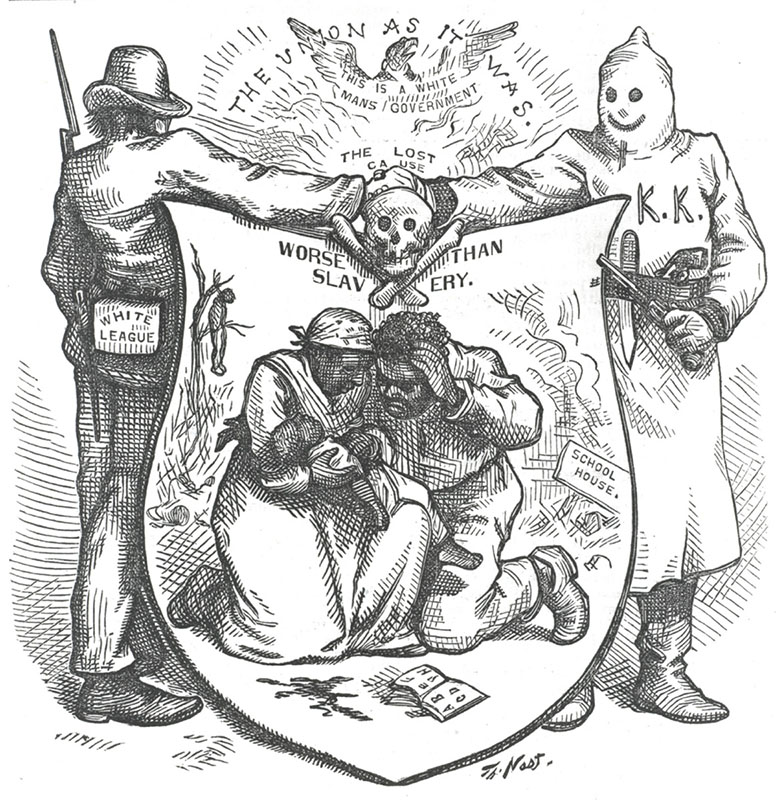

Few times in U.S. history have been as turbulent and transformative as the Civil War and the twelve years that followed. Between 1865 and 1877, one president was murdered and another impeached. The Constitution underwent major revision with the addition of three amendments. The effort to impose Union control and create equality in the defeated South ignited a fierce backlash as various terrorist and vigilante organizations, most notably the A white-supremacist vigilante organization founded in Tennessee in 1866 that used terror, arson, and murder to stop Reconstruction and suppress Black political participation. The post-Civil War process (roughly 1865-1877) of readmitting the former Confederate states to the Union and defining the citizenship and rights of formerly enslaved people.Ku Klux Klan
Reconstruction
The above political cartoon (Figure 16.1) expresses the anguish many Americans felt in the decade after the Civil War. The South, which had experienced catastrophic losses during the conflict, was reduced to political dependence and economic destitution. This humiliating condition led many southern whites to vigorously contest Union efforts to transform the South’s racial, economic, and social landscape. Supporters of equality grew increasingly dismayed at Reconstruction’s failure to undo the old system, which further compounded the staggering regional and racial inequalities in the United States.
✪ 16.1 Restoring the Union#
The end of the Civil War saw the beginning of the Reconstruction era, when former rebel Southern states were integrated back into the Union. President Lincoln moved quickly to achieve the war’s ultimate goal: reunification of the country. He proposed a generous and non-punitive plan to return the former Confederate states speedily to the United States, but some Republicans in Congress protested, considering the president’s plan too lenient to the rebel states that had torn the country apart. The greatest flaw of Lincoln’s plan, according to this view, was that it appeared to forgive traitors instead of guaranteeing Legal and political rights guaranteed to all citizens, at issue in Reconstruction-era debates over the status of formerly enslaved African Americans.civil rights
THE PRESIDENT’S PLAN#
From the outset of the rebellion in 1861, Lincoln’s overriding goal had been to bring the Southern states quickly back into the fold in order to restore the Union (Figure 16.3). In early December 1863, the president began the process of reunification by unveiling a three-part proposal known as the Lincoln's 1863 proposal to readmit former Confederate states once 10 percent of their 1860 voters swore future allegiance to the Union and accepted emancipation. The legal and practical process of freeing enslaved African Americans during the Civil War, culminating in the 13th Amendment and fundamental transformation of American society.ten percent plan
emancipation of slaves

Lincoln hoped that the leniency of the plan—90 percent of the 1860 voters did not have to swear allegiance to the Union or to emancipation—would bring about a quick and long-anticipated resolution and make emancipation more acceptable everywhere. This approach appealed to some in the moderate wing of the Republican Party, which wanted to put the nation on a speedy course toward reconciliation. However, the proposal instantly drew fire from a larger faction of Republicans in Congress who did not want to deal moderately with the South. These members of Congress, known as Northern Republicans in Congress who rejected Lincoln's and Johnson's lenient terms for the South and demanded stronger guarantees of Black civil and political rights.Radical Republicans
In February 1864, two of the Radical Republicans, Ohio senator Benjamin Wade and Maryland representative Henry Winter Davis, answered Lincoln with a proposal of their own. Among other stipulations, the Wade-Davis Bill called for a majority of voters and government officials in Confederate states to take an oath, called the The oath the 1864 Wade-Davis Bill would have required a majority of southern voters and officials to swear, affirming they had never supported the Confederacy.Ironclad Oath
THE THIRTEENTH AMENDMENT#
Despite the 1863 Emancipation Proclamation, the legal status of slaves and the institution of slavery remained unresolved. To deal with the remaining uncertainties, the Republican Party made the abolition of slavery a top priority by including the issue in its 1864 party platform. The platform read: “That as slavery was the cause, and now constitutes the strength of this Rebellion, and as it must be, always and everywhere, hostile to the principles of Republican Government, justice and the National safety demand its utter and complete extirpation from the soil of the Republic; and that, while we uphold and maintain the acts and proclamations by which the Government, in its own defense, has aimed a deathblow at this gigantic evil, we are in favor, furthermore, of such an amendment to the Constitution, to be made by the people in conformity with its provisions, as shall terminate and forever prohibit the existence of Slavery within the limits of the jurisdiction of the United States.” The platform left no doubt about the intention to abolish slavery.
The president, along with the Radical Republicans, made good on this campaign promise in 1864 and 1865. A proposed constitutional amendment passed the Senate in April 1864, and the House of Representatives concurred in January 1865. The amendment then made its way to the states, where it swiftly gained the necessary support, including in the South. In December 1865, the Thirteenth Amendment was officially ratified and added to the Constitution. The first amendment added to the Constitution since 1804, it overturned a centuries-old practice by permanently abolishing slavery.
President Lincoln never saw the final ratification of the Thirteenth Amendment. On April 14, 1865, the Confederate supporter and well-known actor John Wilkes Booth shot Lincoln while he was attending a play, Our American Cousin, at Ford’s Theater in Washington. The president died the next day (Figure 16.4). Booth had steadfastly defended the Confederacy and The racist ideology that white people are superior to other races, used during Reconstruction to justify violent resistance to Black civil and political rights.white supremacy

📌 Figure 16.4 In The Assassination of President Lincoln (1865), by Currier and Ives, John Wilkes Booth shoots Lincoln in the back of the head as he sits in the theater box with his wife, Mary Todd Lincoln, and their guests, Major Henry R. Rathbone and Clara Harris.
ANDREW JOHNSON AND THE BATTLE OVER RECONSTRUCTION#
Lincoln’s assassination elevated Vice President Andrew Johnson, a Democrat, to the presidency. Johnson had come from very humble origins. Born into extreme poverty in North Carolina and having never attended school, Johnson was the picture of a self-made man. His wife had taught him how to read and he had worked as a tailor, a trade he had been apprenticed to as a child. In Tennessee, where he had moved as a young man, he gradually rose up the political ladder, earning a reputation for being a skillful stump speaker and a staunch defender of poor southerners. He was elected to serve in the House of Representatives in the 1840s, became governor of Tennessee the following decade, and then was elected a U.S. senator just a few years before the country descended into war. When Tennessee seceded, Johnson remained loyal to the Union and stayed in the Senate. As Union troops marched on his home state of North Carolina, Lincoln appointed him governor of the then-occupied state of Tennessee, where he served until being nominated by the Republicans to run for vice president on a Lincoln ticket. The nomination of Johnson, a Democrat and a slaveholding southerner, was a pragmatic decision made by concerned Republicans. It was important for them to show that the party supported all loyal men, regardless of their origin or political persuasion. Johnson appeared an ideal choice, because his nomination would bring with it the support of both pro-Southern elements and the War Democrats who rejected the conciliatory stance of the Copperheads, the northern Democrats who opposed the Civil War.
Unexpectedly elevated to the presidency in 1865, this formerly impoverished tailor’s apprentice and unwavering antagonist of the wealthy southern planter class now found himself tasked with administering the restoration of a destroyed South. Lincoln’s position as president had been that the secession of the Southern states was never legal; that is, they had not succeeded in leaving the Union, therefore they still had certain rights to self-government as states. In keeping with Lincoln’s plan, Johnson desired to quickly reincorporate the South back into the Union on lenient terms and heal the wounds of the nation. This position angered many in his own party. The northern Radical Republican plan for Reconstruction looked to overturn southern society and specifically aimed at ending the plantation system. President Johnson quickly disappointed Radical Republicans when he rejected their idea that the federal government could provide voting rights for freed slaves. The initial disagreements between the president and the Radical Republicans over how best to deal with the defeated South set the stage for further conflict.
In fact, President Johnson’s Proclamation of Amnesty and Reconstruction in May 1865 provided sweeping “amnesty and pardon” to rebellious Southerners. It returned to them their property, with the notable exception of their former slaves, and it asked only that they affirm their support for the Constitution of the United States. Those Southerners exempted from this amnesty included the Confederate political leadership, high-ranking military officers, and persons with taxable property worth more than $20,000. The inclusion of this last category was specifically designed to make it clear to the southern planter class that they had a unique responsibility for the outbreak of hostilities. But it also satisfied Johnson’s desire to exact vengeance on a class of people he had fought politically for much of his life. For this class of wealthy Southerners to regain their rights, they would have to swallow their pride and request a personal pardon from Johnson himself.
For the Southern states, the requirements for readmission to the Union were also fairly straightforward. States were required to hold individual state conventions where they would repeal the ordinances of secession and ratify the Thirteenth Amendment. By the end of 1865, a number of former Confederate leaders were in the Union capital looking to claim their seats in Congress. Among them was Alexander Stephens, the vice president of the Confederacy, who had spent several months in a Boston jail after the war. Despite the outcries of Republicans in Congress, by early 1866 Johnson announced that all former Confederate states had satisfied the necessary requirements. According to him, nothing more needed to be done; the Union had been restored.
Understandably, Radical Republicans in Congress did not agree with Johnson’s position. They, and their northern constituents, greatly resented his lenient treatment of the former Confederate states, and especially the return of former Confederate leaders like Alexander Stephens to Congress. They refused to acknowledge the southern state governments he allowed. As a result, they would not permit senators and representatives from the former Confederate states to take their places in Congress.
Instead, the Radical Republicans created a joint committee of representatives and senators to oversee Reconstruction. In the 1866 congressional elections, they gained control of the House, and in the ensuing years they pushed for the dismantling of the old southern order and the complete reconstruction of the South. This effort put them squarely at odds with President Johnson, who remained unwilling to compromise with Congress, setting the stage for a series of clashes.
✪ 16.2 Congress and the Remaking of the South, 1865-1866#
President Johnson and Congress’s views on Reconstruction grew even further apart as Johnson’s presidency progressed. Congress repeatedly pushed for greater rights for freed people and a far more thorough reconstruction of the South, while Johnson pushed for leniency and a swifter reintegration. President Johnson lacked Lincoln’s political skills and instead exhibited a stubbornness and confrontational approach that aggravated an already difficult situation.
THE FREEDMEN’S BUREAU#
Freed people everywhere celebrated the end of slavery and immediately began to take steps to improve their own condition by seeking what had long been denied to them: land, financial security, education, and the ability to participate in the political process. They wanted to be reunited with family members, grasp the opportunity to make their own independent living, and exercise their right to have a say in their own government.
However, they faced the wrath of defeated but un-reconciled southerners who were determined to keep blacks an impoverished and despised underclass. Recognizing the widespread devastation in the South and the dire situation of freed people, Congress created the Bureau of Refugees, Freedmen, and Abandoned Lands in March 1865, popularly known as the A federal agency (1865-1872) created to assist formerly enslaved people and poor whites in the postwar South with food, housing, education, labor contracts, and legal disputes.Freedmen’s Bureau
The Freedmen’s Bureau engaged in many initiatives to ease the transition from slavery to freedom. It delivered food to blacks and whites alike in the South. It helped freed people gain labor contracts, a significant step in the creation of wage labor in place of slavery. It helped reunite families of freedmen, and it also devoted much energy to education, establishing scores of public schools where freed people and poor whites could receive both elementary and higher education. Respected institutions such as Fisk University, Hampton University, and Dillard University are part of the legacy of the Freedmen’s Bureau.
In this endeavor, the Freedmen’s Bureau received support from Christian organizations that had long advocated for abolition, such as the American Missionary Association (AMA). The AMA used the knowledge and skill it had acquired while working in missions in Africa and with American Indian groups to establish and run schools for freed slaves in the postwar South. While men and women, white and black, taught in these schools, the opportunity was crucially important for participating women (Figure 16.5). At the time, many opportunities, including admission to most institutes of higher learning, remained closed to women. Participating in these schools afforded these women the opportunities they otherwise may have been denied. Additionally, the fact they often risked life and limb to work in these schools in the South demonstrated to the nation that women could play a vital role in American civic life.

The schools that the Freedmen’s Bureau and the AMA established inspired great dismay and resentment among the white populations in the South and were sometimes targets of violence. Indeed, the Freedmen’s Bureau’s programs and its very existence were sources of controversy. Racists and others who resisted this type of federal government activism denounced it as both a waste of federal money and a foolish effort that encouraged laziness among blacks. Congress renewed the bureau’s charter in 1866, but President Johnson, who steadfastly believed that the work of restoring the Union had been completed, vetoed the re-chartering. Radical Republicans continued to support the bureau, igniting a contest between Congress and the president that intensified during the next several years. Part of this dispute involved conflicting visions of the proper role of the federal government. Radical Republicans believed in the constructive power of the federal government to ensure a better day for freed people. Others, including Johnson, denied that the government had any such role to play.
BLACK CODES#
In 1865 and 1866, as Johnson announced the end of Reconstruction, southern states began to pass a series of discriminatory state laws collectively known as Discriminatory state laws passed across the South in 1865-1866 that restricted formerly enslaved people's civic rights and tied them to plantation labor in the absence of slavery itself.black codes
A chief component of the black codes was designed to fulfill an important economic need in the postwar South. Slavery had been a pillar of economic stability in the region before the war. To maintain agricultural production, the South had relied on slaves to work the land. Now the region was faced with the daunting prospect of making the transition from a slave economy to one where labor was purchased on the open market. Not surprisingly, planters in the southern states were reluctant to make such a transition. Instead, they drafted black laws that would re-create the antebellum economic structure with the façade of a free-labor system.
Black codes used a variety of tactics to tie freed slaves to the land. To work, the freed slaves were forced to sign contracts with their employer. These contracts prevented blacks from working for more than one employer. This meant that, unlike in a free labor market, blacks could not positively influence wages and conditions by choosing to work for the employer who gave them the best terms. The predictable outcome was that freed slaves were forced to work for very low wages. With such low wages, and no ability to supplement income with additional work, workers were reduced to relying on loans from their employers. The debt that these workers incurred ensured that they could never escape from their condition. Those former slaves who attempt to violate these contracts could be fined or beaten. Those who refused to sign contracts at all could be arrested for vagrancy and then made to work for no wages, essentially being reduced to the very definition of a slave.
The black codes left no doubt that the former breakaway Confederate states intended to maintain white supremacy at all costs. These draconian state laws helped spur the congressional Joint Committee on Reconstruction into action. Its members felt that ending slavery with the Thirteenth Amendment did not go far enough. Congress extended the life of the Freedmen’s Bureau to combat the black codes and in April 1866 passed the first Civil Rights Act, which established the citizenship of African Americans. This was a significant step that contradicted the Supreme Court’s 1857 Dred Scott decision, which declared that blacks could never be citizens. The law also gave the federal government the right to intervene in state affairs to protect the rights of citizens, and thus, of African Americans. President Johnson, who continued to insist that restoration of the United States had already been accomplished, vetoed the 1866 Civil Rights Act. However, Congress mustered the necessary votes to override his veto. Despite the Civil Rights Act, the black codes endured, forming the foundation of the racially discriminatory Jim Crow segregation policies that impoverished generations of African Americans.
THE FOURTEENTH AMENDMENT#
Questions swirled about the constitutionality of the First federal law to define citizenship and protect civil rights for recently freed slaves, passed over President Andrew Johnson's veto.Civil Rights Act of 1866
The Fourteenth Amendment stated, “All persons born or naturalized in the United States and subject to the jurisdiction thereof, are citizens of the United States and of the State wherein they reside.” It gave citizens equal protection under both the state and federal law, overturning the Dred Scott decision. It eliminated the three-fifths compromise of the 1787 Constitution, whereby slaves had been counted as three-fifths of a free white person, and it reduced the number of House representatives and Electoral College electors for any state that denied suffrage to any adult male inhabitant, black or white. As Radical Republicans had proposed in the Wade-Davis bill, individuals who had “engaged in insurrection or rebellion [against] . . . or given aid or comfort to the enemies [of]” the United States were barred from holding political (state or federal) or military office unless pardoned by two-thirds of Congress.
The amendment also answered the question of debts arising from the Civil War by specifying that all debts incurred by fighting to defeat the Confederacy would be honored. Confederate debts, however, would not: “[N]either the United States nor any State shall assume or pay any debt or obligation incurred in aid of insurrection or rebellion against the United States, or any claim for the loss or emancipation of any slave; but all such debts, obligations and claims shall be held illegal and void.” Thus, claims by former slaveholders requesting compensation for slave property had no standing. Any state that ratified the Fourteenth Amendment would automatically be readmitted. Most former Confederate states, except for Tennessee, refused to ratify the amendment in 1866.
President Johnson called openly for the rejection of the Fourteenth Amendment, a move that drove a further wedge between him and congressional Republicans. In late summer of 1866, he gave a series of speeches, known as the “swing around the circle,” designed to gather support for his mild version of Reconstruction. Johnson felt that ending slavery went far enough; extending the rights and protections of citizenship to freed people, he believed, went much too far. He continued to believe that blacks were inferior to whites. The president’s “swing around the circle” speeches to gain support for his program and derail the Radical Republicans proved to be a disaster, as hecklers provoked Johnson to make damaging statements. Radical Republicans charged that Johnson had been drunk when he made his speeches. As a result, Johnson’s reputation plummeted.
✪ 16.3 Radical reconstruction, 1867-1872#
During the Congressional election in the fall of 1866, Republicans gained even greater victories. This was due in large measure to the northern voter opposition that had developed toward President Johnson because of the inflexible and overbearing attitude he had exhibited in the White House, as well as his missteps during his 1866 speaking tour. Leading Radical Republicans in Congress included Massachusetts senator Charles Sumner (the same senator whom proslavery South Carolina representative Preston Brooks had thrashed with his cane in 1856 during the Bleeding Kansas crisis) and Pennsylvania representative Thaddeus Stevens. These men and their supporters envisioned a much more expansive change in the South. Sumner advocated integrating schools and giving black men the right to vote while disenfranchising many southern voters. For his part, Stevens considered that the southern states had forfeited their rights as states when they seceded, and were no more than conquered territory that the federal government could organize as it wished. He envisioned the redistribution of plantation lands and U.S. military control over the former Confederacy.
Their goals included the transformation of the South from an area built on slave labor to a free-labor society. They also wanted to ensure that freed people were protected and given the opportunity for a better life. Violent race riots in Memphis, Tennessee, and New Orleans, Louisiana, in 1866 gave greater urgency to the second phase of Reconstruction, begun in 1867.
THE RECONSTRUCTION ACTS#
The 1867 Military Reconstruction Act, which encompassed the vision of Radical Republicans, set a new direction for Reconstruction in the South. Republicans saw this law, and three supplementary laws passed by Congress that year, called the Series of federal laws passed in 1867 to govern the Reconstruction of Southern states, mandating political reforms and establishing conditions for readmission to the Union.Reconstruction Acts

THE IMPEACHMENT OF PRESIDENT JOHNSON#
President Johnson’s relentless vetoing of congressional measures created a deep rift in Washington, DC, and neither he nor Congress would back down. Johnson’s prickly personality proved to be a liability, and many people found him grating. Moreover, he firmly believed in white supremacy, declaring in his 1868 State of the Union address, “The attempt to place the white population under the domination of persons of color in the South has impaired, if not destroyed, the kindly relations that had previously existed between them; and mutual distrust has engendered a feeling of animosity which leading in some instances to collision and bloodshed, has prevented that cooperation between the two races so essential to the success of industrial enterprise in the southern states.” The president’s racism put him even further at odds with those in Congress who wanted to create full equality between blacks and whites.
The Republican majority in Congress by now despised the president, and they wanted to prevent him from interfering in congressional Reconstruction. To that end, Radical Republicans passed two laws of dubious constitutionality. The Command of the Army Act prohibited the president from issuing military orders except through the commanding general of the army, who could not be relieved or reassigned without the consent of the Senate. The Tenure of Office Act, which Congress passed in 1867, required the president to gain the approval of the Senate whenever he appointed or removed officials. Congress had passed this act to ensure that Republicans who favored Radical Reconstruction would not be barred or stripped of their jobs. In August 1867, President Johnson removed Secretary of War Edwin M. Stanton, who had aligned himself with the Radical Republicans, without gaining Senate approval. He replaced Stanton with Ulysses S. Grant, but Grant resigned and sided with the Republicans against the president. Many Radical Republicans welcomed this blunder by the president as it allowed them to take action to remove Johnson from office, arguing that Johnson had openly violated the Tenure of Office Act. The House of Representatives quickly drafted a resolution to impeach him, a first in American history.
In impeachment proceedings, the House of Representatives serves as the prosecution and the Senate acts as judge, deciding whether the president should be removed from office (Figure 16.8). The House brought eleven counts against Johnson, all alleging his encroachment on the powers of Congress. In the Senate, Johnson barely survived. Seven Republicans joined the Democrats and independents to support acquittal; the final vote was 35 to 19, one vote short of the required two-thirds majority. The Radicals then dropped the impeachment effort, but the events had effectively silenced President Johnson, and Radical Republicans continued with their plan to reconstruct the South.

THE FIFTEENTH AMENDMENT#
In November 1868, Ulysses S. Grant, the Union’s war hero, easily won the presidency in a landslide victory. The Democratic nominee was Horatio Seymour, but the Democrats carried the stigma of disunion. The Republicans, in their campaign, blamed the devastating Civil War and the violence of its aftermath on the rival party, a strategy that southerners called “waving the bloody shirt.”
Though Grant did not side with the Radical Republicans, his victory allowed the continuance of the Radical Reconstruction program. In the winter of 1869, Republicans introduced another constitutional amendment, the third of the Reconstruction era. When Republicans had passed the Fourteenth Amendment, which addressed citizenship rights and equal protections, they were unable to explicitly ban states from withholding the franchise based on race. With the Fifteenth Amendment, they sought to correct this major weakness by finally extending to black men the right to vote. The amendment directed that “[t]he right of citizens of the United States to vote shall not be denied or abridged by the United States or by any State on account of race, color, or previous condition of servitude.” Unfortunately, the new amendment had weaknesses of its own. As part of a compromise to ensure the passage of the amendment with the broadest possible support, drafters of the amendment specifically excluded language that addressed literacy tests and poll taxes, the most common ways blacks were traditionally disenfranchised in both the North and the South. Indeed, Radical Republican leader Charles Sumner of Massachusetts, himself an ardent supporter of legal equality without exception to race, refused to vote for the amendment precisely because it did not address these obvious loopholes.
Despite these weaknesses, the language of the amendment did provide for universal manhood suffrage—the right of all men to vote—and crucially identified black men, including those who had been slaves, as deserving the right to vote. This, the third and final of the Reconstruction amendments, was ratified in 1870 (Figure 16.9). With the ratification of the Fifteenth Amendment, many believed that the process of restoring the Union was safely coming to a close and that the rights of freed slaves were finally secure. African American communities expressed great hope as they celebrated what they understood to be a national confirmation of their unqualified citizenship.

WOMEN’S SUFFRAGE#
While the Fifteenth Amendment may have been greeted with applause in many corners, leading women’s rights activists, who had been campaigning for decades for the right to vote, saw it as a major disappointment. More dispiriting still was the fact that many women’s rights activists, such as Susan B. Anthony and Elizabeth Cady Stanton, had played a large part in the abolitionist movement leading up to the Civil War. Following the war, women and men, white and black, formed the American Equal Rights Association (AERA) for the expressed purpose of securing “equal Rights to all American citizens, especially the right of suffrage, irrespective of race, color or sex.” Two years later, with the adoption of the Fourteenth Amendment, section 2 of which specifically qualified the liberties it extended to “male citizens,” it seemed as though the progress made in support of civil rights was not only passing women by but was purposely codifying their exclusion. As Congress debated the language of the Fifteenth Amendment, some held out hope that it would finally extend the franchise to women. Those hopes were dashed when Congress adopted the final language.
The consequence of these frustrated hopes was the effective split of a civil rights movement that had once been united in support of African Americans and women. Seeing this split occur, Frederick Douglass, a great admirer of Stanton, struggled to argue for a piecemeal approach that should prioritize the franchise for black men if that was the only option. He insisted that his support for women’s right to vote was sincere, but that getting black men the right to vote was “of the most urgent necessity.” “The government of this country loves women,” he argued. “They are the sisters, mothers, wives and daughters of our rulers; but the negro is loathed. . . . The negro needs suffrage to protect his life and property, and to ensure him respect and education.”
These appeals were largely accepted by women’s rights leaders and AERA members like Lucy Stone and Henry Browne Blackwell, who believed that more time was needed to bring about female suffrage. Others demanded immediate action. Among those who pressed forward despite the setback were Stanton and Anthony. They felt greatly aggrieved at the fact that other abolitionists, with whom they had worked closely for years, did not demand that women be included in the language of the amendments. Stanton argued that the women’s vote would be necessary to counter the influence of uneducated freedmen in the South and the waves of poor European immigrants arriving in the East.
In 1869, Stanton and Anthony helped organize the National Woman Suffrage Association (NWSA), an organization dedicated to ensuring that women gained the right to vote immediately, not at some future, undetermined date. Some women, including Virginia Minor, a member of the NWSA, took action by trying to register to vote; Minor attempted this in St. Louis, Missouri, in 1872. When election officials turned her away, Minor brought the issue to the Missouri state courts, arguing that the Fourteenth Amendment ensured that she was a citizen with the right to vote. This legal effort to bring about women’s suffrage eventually made its way to the Supreme Court, which declared in 1874 that “the constitution of the United States does not confer the right of suffrage upon any one,” effectively dismissing Minor’s claim.
BLACK POLITICAL ACHIEVEMENTS#
Black voter registration in the late 1860s and the ratification of the Fifteenth Amendment finally brought what Lincoln had characterized as “a new birth of freedom.” Fraternal organizations, originally founded in the North to promote Union loyalty, that expanded into the postwar South as political and civic clubs organizing Black voters for the Republican Party.Union Leagues

The political activities of the leagues launched a great many African Americans and former slaves into politics throughout the South. For the first time, blacks began to hold political office, and several were elected to the U.S. Congress. In the 1870s, fifteen members of the House of Representatives and two senators were black. The two senators, Blanche K. Bruce and Hiram Revels, were both from Mississippi, the home state of former U.S. senator and later Confederate president Jefferson Davis. Hiram Revels (Figure 16.11), was a freeborn man from North Carolina who rose to prominence as a minister in the African Methodist Episcopal Church and then as a Mississippi state senator in 1869. The following year he was elected by the state legislature to fill one of Mississippi’s two U.S. Senate seats, which had been vacant since the war. His arrival in Washington, DC, drew intense interest: as the New York Times noted, when “the colored Senator from Mississippi, was sworn in and admitted to his seat this afternoon . . . there was not an inch of standing or sitting room in the galleries, so densely were they packed. . . . When the Vice-President uttered the words, ‘The Senator elect will now advance and take the oath,’ a pin might have been heard drop.”

Though the fact of their presence was dramatic and important, as the New York Times description above demonstrates, the few African American representatives and senators who served in Congress during Reconstruction represented only a tiny fraction of the many hundreds, possibly thousands, of blacks who served in a great number of capacities at the local and state levels. The South during the early 1870s brimmed with freed slaves and freeborn blacks serving as school board commissioners, county commissioners, clerks of court, board of education and city council members, justices of the peace, constables, coroners, magistrates, sheriffs, auditors, and registrars. This wave of local African American political activity contributed to and was accompanied by a new concern for the poor and disadvantaged in the South. The southern Republican leadership did away with the hated black codes, undid the work of white supremacists, and worked to reduce obstacles confronting freed people.
Reconstruction governments invested in infrastructure, paying special attention to the rehabilitation of the southern railroads. They set up public education systems that enrolled both white and black students. They established or increased funding for hospitals, orphanages, and asylums for the insane. In some states, the state and local governments provided the poor with basic necessities like firewood and even bread. And to pay for these new services and subsidies, the governments levied taxes on land and property, an action that struck at the heart of the foundation of southern economic inequality. Indeed, the land tax compounded the existing problems of white landowners, who were often cash-poor, and contributed to resentment of what southerners viewed as another northern attack on their way of life.
White southerners reacted with outrage at the changes imposed upon them. The sight of once-enslaved blacks serving in positions of authority as sheriffs, congressmen, and city council members stimulated great resentment at the process of Reconstruction and its undermining of the traditional social and economic foundations of the South. Indignant southerners referred to this period of reform as a time of “negro misrule.” They complained of profligate corruption on the part of vengeful freed slaves and greedy northerners looking to fill their pockets with the South’s riches. Unfortunately for the great many honest reformers, southerners did have a handful of real examples of corruption they could point to, such as legislators using state revenues to buy hams and perfumes or giving themselves inflated salaries. Such examples, however, were relatively few and largely comparable to nineteenth-century corruption across the country. Yet these powerful stories, combined with deep-seated racial animosity toward blacks in the South, led to Democratic campaigns to “redeem” state governments. Democrats across the South leveraged planters’ economic power and wielded white vigilante violence to ultimately take back state political power from the Republicans. By the time President Grant’s attentions were being directed away from the South and toward the Indian Wars in the West in 1876, power in the South had largely been returned to whites and Reconstruction was effectively abandoned. By the end of 1876, only South Carolina, Louisiana, and Florida still had Republican governments.
The sense that the South had been unfairly sacrificed to northern vice and black vengeance, despite a wealth of evidence to the contrary, persisted for many decades. So powerful and pervasive was this narrative that by the time D. W. Griffith released his 1915 motion picture, The Birth of a Nation, whites around the country were primed to accept the fallacy that white southerners were the frequent victims of violence and violation at the hands of unrestrained blacks. The reality is that the opposite was true. White southerners orchestrated a sometimes violent and generally successful counterrevolution against Reconstruction policies in the South beginning in the 1860s. Those who worked to change and modernize the South typically did so under the stern gaze of exasperated whites and threats of violence. Black Republican officials in the South were frequently terrorized, assaulted, and even murdered with impunity by organizations like the Ku Klux Klan. When not ignoring the Fourteenth and Fifteenth Amendments altogether, white leaders often used trickery and fraud at the polls to get the results they wanted. As Reconstruction came to a close, these methods came to define southern life for African Americans for nearly a century afterward.
✪ 16.4 The Collapse of Reconstruction#
The effort to remake the South generated a brutal reaction among southern whites, who were committed to keeping blacks in a subservient position. To prevent blacks from gaining economic ground and to maintain cheap labor for the agricultural economy, an exploitative system of A postwar southern farm-labor system in which freed people rented land -- often on the same plantations where they had been enslaved -- and paid landlords with a share of the crop they grew.sharecropping
BUILDING BLACK COMMUNITIES#
The degraded status of black men and women had placed them outside the limits of what antebellum southern whites considered appropriate gender roles and familial hierarchies. Slave marriages did not enjoy legal recognition. Enslaved men were humiliated and deprived of authority and of the ability to protect enslaved women, who were frequently exposed to the brutality and sexual domination of white masters and vigilantes alike. Slave parents could not protect their children, who could be bought, sold, put to work, brutally disciplined, and abused without their consent; parents, too, could be sold away from their children (Figure 16.12). Moreover, the division of labor idealized in white southern society, in which men worked the land and women performed the role of domestic caretaker, was null and void where slaves were concerned. Both slave men and women were made to perform hard labor in the fields.

In the Reconstruction era, African Americans embraced the right to enjoy the family bonds and the expression of gender norms they had been systematically denied. Many thousands of freed black men who had been separated from their families as slaves took to the road to find their long-lost spouses and children and renew their bonds. In one instance, a journalist reported having interviewed a freed slave who traveled over six hundred miles on foot in search of the family that was taken from him while in bondage. Couples that had been spared separation quickly set out to legalize their marriages, often by way of the Freedmen’s Bureau, now that this option was available. Those who had no families would sometimes relocate to southern towns and cities, so as to be part of the larger black community where churches and other mutual aid societies offered help and camaraderie.
THE “INVISIBLE EMPIRE OF THE SOUTH”#
Paramilitary white-supremacist terror organizations in the South helped bring about the collapse of Reconstruction, using violence as their primary weapon. The “Invisible Empire of the South,” or Ku Klux Klan, stands as the most notorious. The Klan was founded in 1866 as an oath-bound fraternal order of Confederate veterans in Tennessee, with former Confederate General Nathan Bedford Forrest as its first leader. The organization—its name likely derived from kuklos, a Greek word meaning circle—devised elaborate rituals and grandiose names for its ranking members: Grand Wizard, Grand Dragon, Grand Titan, and Grand Cyclops. Soon, however, this fraternal organization evolved into a vigilante terrorist group that vented southern whites’ collective frustration over the loss of the war and the course of Radical Reconstruction through acts of intimidation and violence.
The Klan terrorized newly freed blacks to deter them from exercising their citizenship rights and freedoms. Other anti-black vigilante groups around the South began to adopt the Klan name and perpetrate acts of unspeakable violence against anyone they considered a tool of Reconstruction. Indeed, as historians have noted, Klan units around the South operated autonomously and with a variety of motives. Some may have sincerely believed they were righting wrongs, others merely satisfying their lurid desires for violence. Nor was the Klan the only racist vigilante organization. Other groups, like the Red Shirts from Mississippi and the Knights of the White Camelia and the White League, both from Louisiana, also sprang up at this time. The Klan and similar organizations also worked as an extension of the Democratic Party to win elections.
Despite the great variety in Klan membership, on the whole, the group tended to direct its attention toward persecuting freed people and people they considered A term of abuse for northerners accused of moving south during Reconstruction to profit from political power at former Confederates' expense. A pejorative term for white southerners who supported Reconstruction and cooperated with Republican state governments, viewed by other white southerners as traitors.carpetbaggers
scalawags
The Klan seized on the pervasive but largely fictional narrative of the northern carpetbagger as a powerful tool for restoring white supremacy and overturning Republican state governments in the South (Figure 16.13). To preserve a white-dominated society, Klan members punished blacks for attempting to improve their station in life or acting “uppity.” To prevent freed people from attaining an education, the Klan burned public schools. In an effort to stop blacks from voting, the Klan murdered, whipped, and otherwise intimidated freed people and their white supporters. It wasn’t uncommon for Klan members to intimidate Union League members and Freedmen’s Bureau workers. The Klan even perpetrated acts of political assassination, killing a sitting U.S. congressman from Arkansas and three state congressmen from South Carolina.

Klan tactics included riding out to victims’ houses, masked and armed, and firing into the homes or burning them down (Figure 16.14). Other tactics relied more on the threat of violence, such as happened in Mississippi when fifty masked Klansmen rode out to a local schoolteacher’s house to express their displeasure with the school tax and to suggest that she consider leaving. Still other tactics intimidated through imaginative trickery. One such method was to dress up as ghosts of slain Confederate soldiers and stage stunts designed to convince their victims of their supernatural abilities.

Regardless of the method, the general goal of reinstating white supremacy as a foundational principle and returning the South to a situation that largely resembled antebellum conditions remained a constant. The Klan used its power to eliminate black economic independence, decimate blacks’ political rights, reclaim white dominance over black women’s bodies and black men’s masculinity, tear apart black communities, and return blacks to earlier patterns of economic and political subservience and social deference. In this, they were largely successful.
The president and Congress, however, were not indifferent to the violence, and they worked to bring it to an end. In 1870, at the insistence of the governor of North Carolina, President Grant told Congress to investigate the Klan. In response, Congress in 1871 created the Joint Select Committee to Inquire into the Condition of Affairs in the Late Insurrectionary States. The committee took testimony from freed people in the South, and in 1872, it published a thirteen-volume report on the tactics the Klan used to derail democracy in the South through the use of violence.
Congress also passed a series of three laws designed to stamp out the Klan. Passed in 1870 and 1871, the Enforcement Acts or “Force Acts” were designed to outlaw intimidation at the polls and to give the federal government the power to prosecute crimes against freed people in federal rather than state courts. Congress believed that this last step, a provision in the third Enforcement Act, also called the Ku Klux Klan Act, was necessary in order to ensure that trials would not be decided by white juries in southern states friendly to the Klan. The act also allowed the president to impose martial law in areas controlled by the Klan and gave President Grant the power to suspend the writ of habeas corpus, a continuation of the wartime power granted to President Lincoln. The suspension meant individuals suspected of engaging in Klan activity could be jailed indefinitely.
President Grant made frequent use of the powers granted to him by Congress, especially in South Carolina, where federal troops imposed martial law in nine counties in an effort to derail Klan activities. However, the federal government faced entrenched local organizations and a white population firmly opposed to Radical Reconstruction. Changes came slowly or not at all, and disillusionment set in. After 1872, federal government efforts to put down paramilitary terror in the South waned.
“REDEEMERS” AND THE END OF RECONSTRUCTION#
While the president and Congress may have seen the Klan and other clandestine white supremacist, terrorist organizations as a threat to stability and progress in the South, many southern whites saw them as an instrument of order in a world turned upside down. Many white southerners felt humiliated by the process of Radical Reconstruction and the way Republicans had upended southern society, placing blacks in positions of authority while taxing large landowners to pay for the education of former slaves. Those committed to rolling back the tide of Radical Reconstruction in the South called themselves Southern Democrats committed to overturning Radical Reconstruction and restoring white political control, who succeeded across the South by 1877.redeemers
Although Ulysses S. Grant won a second term in the presidential election of 1872, the Republican grip on national political power began to slip in the early 1870s. Three major events undermined Republican control. First, in 1873, the United States experienced the start of a long economic downturn, the result of economic instability in Europe that spread to the United States. In the fall of 1873, the bank of Jay Cooke & Company failed to meet its financial obligations and went bankrupt, setting off a panic in American financial markets. An economic depression ensued, which Democrats blamed on Republicans and which lasted much of the decade.
Second, the Republican Party experienced internal squabbles and divided into two factions. Some Republicans began to question the expansive role of the federal government, arguing for limiting the size and scope of federal initiatives. These advocates, known as Liberal Republicans because they followed classical liberalism in championing small government, formed their own breakaway party. Their ideas changed the nature of the debate over Reconstruction by challenging reliance on federal government help to bring about change in the South. Now some Republicans argued for downsizing Reconstruction efforts.
Third, the Grant administration became mired in scandals, further tarnishing the Republicans while giving Democrats the upper hand. One scandal arose over the siphoning off of money from excise taxes on whiskey. The “Whiskey Ring,” as it was called, involved people at the highest levels of the Grant administration, including the president’s personal secretary, Orville Babcock. Another scandal entangled Crédit Mobilier of America, a construction company and part of the important French Crédit Mobilier banking company. The Union Pacific Railroad company, created by the federal government during the Civil War to construct a transcontinental railroad, paid Crédit Mobilier to build the railroad. However, Crédit Mobilier used the funds it received to buy Union Pacific Railroad bonds and resell them at a huge profit. Some members of Congress, as well as Vice President Schuyler Colfax, had accepted funds from Crédit Mobilier in return for forestalling an inquiry. When the scam became known in 1872, Democratic opponents of Reconstruction pointed to Crédit Mobilier as an example of corruption in the Republican-dominated federal government and evidence that smaller government was better.
The Democratic Party in the South made significant advances in the 1870s in its efforts to wrest political control from the Republican-dominated state governments. The Ku Klux Klan, as well as other paramilitary groups in the South, often operated as military wings of the Democratic Party in former Confederate states. In one notorious episode following a contested 1872 gubernatorial election in Louisiana, as many as 150 freedmen loyal to the Republican Party were killed at the Colfax courthouse by armed members of the Democratic Party, even as many of them tried to surrender (Figure 16.15).

In other areas of the South, the Democratic Party gained control over state politics. Texas came under Democratic control by 1873, and in the following year Alabama and Arkansas followed suit. In national politics, too, the Democrats gained ground—especially during the 1874 elections, when they recaptured control of the House of Representatives for the first time since before the Civil War. Every other southern state, with the exception of Florida, South Carolina, and Louisiana—the states where federal troops remained a force—also fell to the Democratic Party and the restoration of white supremacy. Southerners everywhere celebrated their “redemption” from Radical Republican rule.
THE CONTESTED ELECTION OF 1876#
By the time of the 1876 presidential election, Reconstruction had come to an end in most southern states. In Congress, the political power of the Radical Republicans had waned, although some continued their efforts to realize the dream of equality between blacks and whites. One of the last attempts to do so was the passage of the 1875 Civil Rights Act, which required equality in public places and on juries. This law was challenged in court, and in 1883 the Supreme Court ruled it unconstitutional, arguing that the Thirteenth and Fourteenth Amendments did not prohibit discrimination by private individuals. By the 1870s, the Supreme Court had also undercut the letter and the spirit of the Fourteenth Amendment by interpreting it as affording freed people only limited federal protection from the Klan and other terror groups.
The country remained bitterly divided, and this was reflected in the contested election of 1876. While Grant wanted to run for a third term, scandals and Democratic successes in the South dashed those hopes. Republicans instead selected Rutherford B. Hayes, the three-time governor of Ohio. Democrats nominated Samuel Tilden, the reform governor of New York, who was instrumental in ending the Tweed Ring and Tammany Hall corruption in New York City. The November election produced an apparent Democratic victory, as Tilden carried the South and large northern states with a 300,000-vote advantage in the popular vote. However, disputed returns from Louisiana, South Carolina, Florida, and Oregon, whose electoral votes totaled twenty, threw the election into doubt.
Hayes could still win if he gained those twenty electoral votes. As the Constitution did not provide a method to determine the validity of disputed votes, the decision fell to Congress, where Republicans controlled the Senate and Democrats controlled the House of Representatives. In late January 1877, Congress tried to break the deadlock by creating a special electoral commission composed of five senators, five representatives, and five justices of the Supreme Court. The congressional delegation represented both parties equally, with five Democrats and five Republicans. The court delegation had two Democrats, two Republicans, and one independent—David Davis, who resigned from the Supreme Court (and from the commission) when the Illinois legislature elected him to the Senate. After Davis’s resignation, President Grant selected a Republican to take his place, tipping the scales in favor of Hayes. The commission then awarded the disputed electoral votes and the presidency to Hayes, voting on party lines, 8 to 7 (Figure 16.16). The Democrats called foul, threatening to hold up the commission’s decision in the courts.

In what became known as the The informal 1877 agreement that awarded Rutherford B. Hayes the contested 1876 presidential election in exchange for the withdrawal of federal troops from the South, effectively ending Reconstruction.Compromise of 1877
❦ Primary and Secondary Sources#
Sources#
Full excerpt text is not yet available for this source. See the full source record.
Key Terms#
14th Amendment
Constitutional amendment passed during Reconstruction to guarantee equal protection and due process for all citizens, particularly addressing the rights of recently freed slaves.
Ku Klux Klan Violence
Systematic campaign of terror and intimidation against African Americans and their supporters during the Reconstruction era, aimed at maintaining white supremacy and undermining racial equality.
Civil War Aftermath
The period immediately following the Civil War, characterized by massive social, political, and economic transformation as the United States sought to reunify and address the consequences of slavery.
13th Amendment
The 13th Amendment, ratified in 1865, formally abolished slavery and involuntary servitude throughout the United States. This groundbreaking amendment represented the culmination of the abolitionist movement and marked a fundamental shift in American society, though its promise of complete freedom w
15th Amendment
Constitutional amendment prohibiting the denial of voting rights based on race, color, or previous condition of servitude, passed in 1870 as a key Reconstruction-era civil rights measure.
Political Struggles in the South
Intense political conflicts in Southern states during Reconstruction, characterized by struggles over governance, representation, and the fundamental restructuring of social and political systems.
Political Representation
The process of including marginalized groups, particularly African Americans, in political institutions and decision-making processes during the Reconstruction era.
Racial Integration
The complex process of breaking down racial barriers and creating more inclusive social, political, and economic institutions during the Reconstruction era.
Political Representation Challenges
The systematic efforts to undermine and restrict African American political participation during and after the Reconstruction era, including legal, social, and violent methods of voter suppression.
-
Frederick Douglass (person)
-
Southern United States (place)
-
Hiram Revels (person)
-
Freedmen's Communities (place)
-
Thaddeus Stevens (person)
-
Andrew Johnson (person)
-
Abraham Lincoln (person)
-
Ulysses S. Grant (person)
-
State Legislatures (place)