United States History · Chapter 14
14. Troubled Times: The Tumultuous 1850s
The 1850s were marked by intense sectional conflict over slavery, highlighted by events such as the Compromise of 1850, which attempted to balance interests between the North and South but ultimately failed to resolve tensions. The Kansas-Nebraska Act further polarized the nation, leading to violent confrontations in "Bleeding Kansas" and the rise of the Republican Party, which opposed the expansion of slavery. The Dred Scott decision deepened the crisis by ruling that African Americans could not be citizens and that Congress could not limit slavery's spread. John Brown's raid on Harpers Ferry in 1859 exemplified the radical abolitionist response, contributing to fears of insurrection in the South and ultimately leading to the secession of Southern states following Lincoln's election in 1860.
Learning Objectives
By the end of this chapter, you will be able to:
- Explain the contested issues that led to the Compromise of 1850
- Describe and analyze the reactions to the 1850 Fugitive Slave Act
- Explain the political ramifications of the Kansas-Nebraska Act
- Describe the founding of the Republican Party
- Explain the importance of the Supreme Court's Dred Scott ruling
- Discuss the principles of the Republican Party as expressed by Abraham Lincoln in 1858
- Describe John Brown’s raid on Harpers Ferry and its results
- Analyze the results of the election of 1860
Introduction#
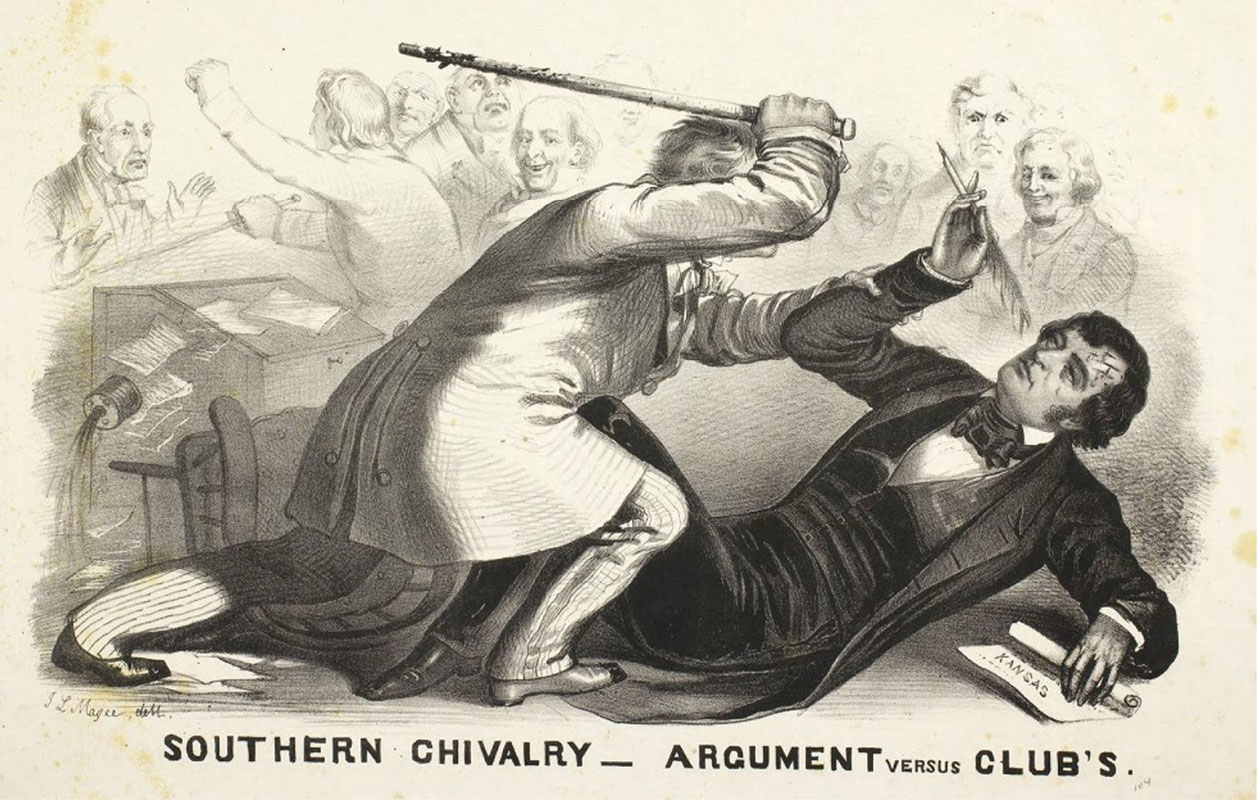
The heated sectional controversy between the North and the South reached new levels of intensity in the 1850s. Southerners and northerners grew ever more antagonistic as they debated the expansion of slavery in the West. The notorious confrontation between Representative Preston Brooks of South Carolina and Massachusetts senator Charles Sumner depicted in the image above (Figure 14.1), illustrates the contempt between extremists on both sides. The “Caning of Sumner” in May 1856 followed upon a speech given by Sumner two days earlier in which he condemned slavery in no uncertain terms, declaring: “[Admitting Kansas as a slave state] is the rape of a virgin territory, compelling it to the hateful embrace of slavery; and it may be clearly traced to a depraved longing for a new slave state, the hideous offspring of such a crime, in the hope of adding to the power of slavery in the national government.” Sumner criticized proslavery legislators, particularly attacking a fellow senator and relative of Preston Brooks. Brooks responded by beating Sumner with a cane, a thrashing that southerners celebrated as a manly defense of gentlemanly honor and their way of life. The episode highlights the violent clash between pro- and antislavery factions in the 1850s, a conflict that would eventually lead to the traumatic unraveling of American democracy and civil war.