United States History · Chapter 10
10. Jacksonian Democracy, 1820–1840
The rise of American democracy between 1820 and 1840 marked a shift from elite rule to majority rule, characterized by Andrew Jackson's presidency. Political participation expanded for white men, while women, free blacks, and Native Americans remained disenfranchised. The election of 1824 highlighted the tensions between popular will and elite influence, culminating in Jackson's victory in 1828. Key issues included the Tariff of 1828, which sparked the Nullification Crisis, and the contentious Bank War, where Jackson opposed the Second Bank of the United States. The Indian Removal Act led to the forced displacement of Native American tribes, exemplifying the era's racial prejudices and the consequences of majority opinion.
Learning Objectives
By the end of this chapter, you will be able to:
- Explain and illustrate the new style of American politics in the 1820s
- Describe the policies of John Quincy Adams’s presidency and explain the political divisions that resulted
- Describe the key points of the election of 1828
- Explain the scandals of Andrew Jackson’s first term in office
- Explain the factors that contributed to the Nullification Crisis
- Discuss the origins and creation of the Whig Party
- Explain the legal wrangling that surrounded the Indian Removal Act
- Describe how depictions of Indians in popular culture helped lead to Indian removal
- Explain Alexis de Tocqueville’s analysis of American democracy
- Describe the election of 1840 and its outcome
Introduction#
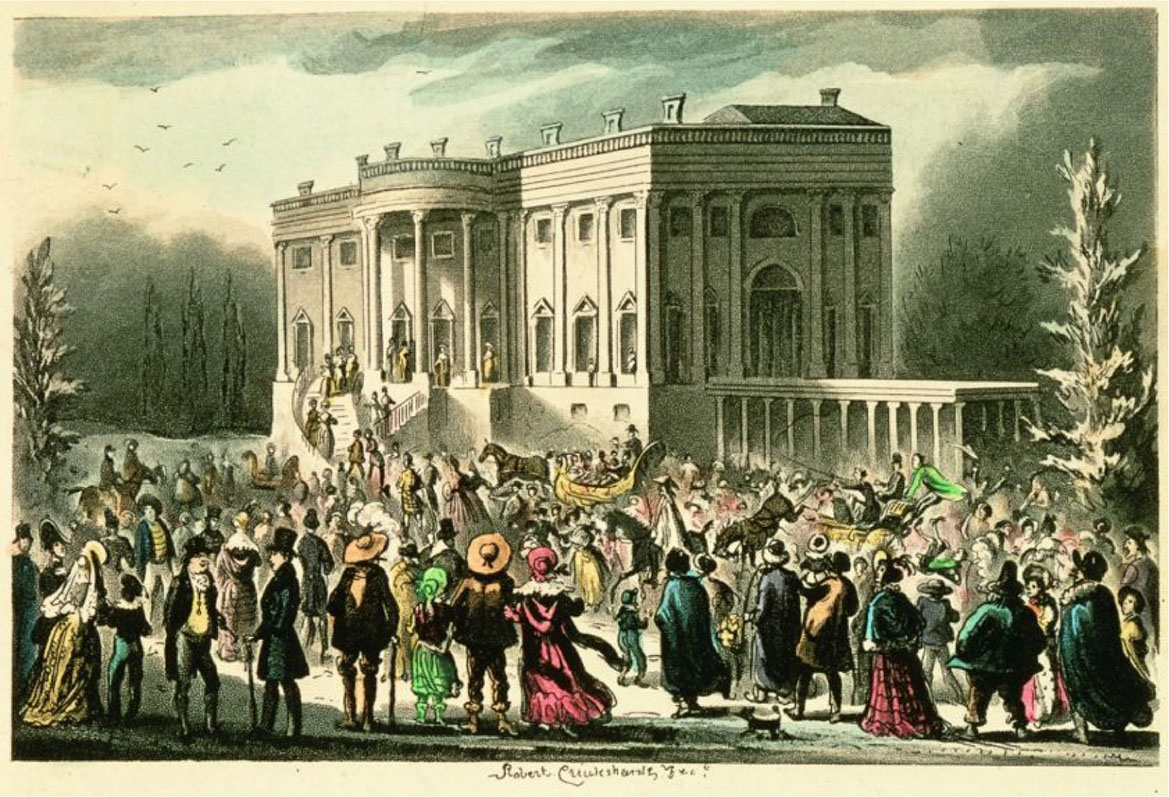
Figure 10.1 In President’s Levee, or all Creation going to the White House, Washington (1841), by Robert Cruikshank, the artist depicts Andrew Jackson’s inauguration in 1829, with crowds surging into the White House to join the celebrations. Rowdy revelers destroyed many White House furnishings in their merriment. A new political era of democracy had begun, one characterized by the rule of the majority.
The most extraordinary political development in the years before the Civil War was the rise of American democracy. Whereas the founders envisioned the United States as a republic, not a democracy, and had placed safeguards such as the Electoral College in the 1787 Constitution to prevent simple majority rule, the early 1820s saw many Americans embracing majority rule and rejecting old forms of deference that were based on elite ideas of virtue, learning, and family lineage.
A new breed of politicians learned to harness the magic of the many by appealing to the resentments, fears, and passions of ordinary citizens to win elections. The charismatic Andrew Jackson gained a reputation as a fighter and defender of American expansion, emerging as the quintessential figure leading the rise of American democracy. In the image above (Figure 10.1), crowds flock to the White House to celebrate his inauguration as president. While earlier inaugurations had been reserved for Washington’s political elite, Jackson’s was an event for the people, so much so that the pushing throngs caused thousands of dollars of damage to White House property. Characteristics of modern American democracy, including the turbulent nature of majority rule, first appeared during the Age of Jackson.