14. Troubled Times: The Tumultuous 1850s
The Dred Scott Decision and Sectional Strife
As president, Buchanan confronted a difficult and volatile situation. The nation needed a strong personality to lead it, and Buchanan did not possess this trait. The violence in Kansas demonstrated that applying popular sovereignty—the democratic principle of majority rule—to the territory offered no solution to the national battle over slavery. A decision by the Supreme Court in 1857, which concerned the slave Dred Scott, only deepened the crisis.
DRED SCOTT#
In 1857, several months after President Buchanan took the oath of office, the Supreme Court ruled in Dred Scott v. SandfordAn 1857 case in which the Supreme Court ruled that blacks could not be citizens and Congress had no jurisdiction to impede the expansion of slavery. Dred Scott (Figure 14.16), born a slave in Virginia in 1795, had been one of the thousands forced to relocate as a result of the massive internal slave trade and taken to Missouri, where slavery had been adopted as part of the Missouri Compromise. In 1820, Scott’s owner took him first to Illinois and then to the Wisconsin territory. However, both of those regions were part of the Northwest Territory, where the 1787 Northwest Ordinance had prohibited slavery. When Scott returned to Missouri, he attempted to buy his freedom. After his owner refused, he sought relief in the state courts, arguing that by virtue of having lived in areas where slavery was banned, he should be free.
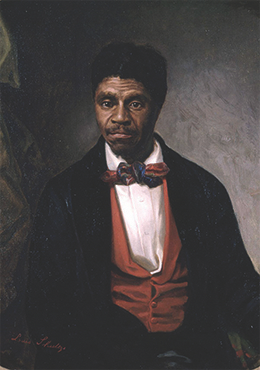
In a complicated set of legal decisions, a jury found that Scott, along with his wife and two children, were free. However, on appeal from Scott’s owner, the state Superior Court reversed the decision, and the Scotts remained slaves. Scott then became the property of John Sanford (his name was misspelled as “Sandford” in later court documents), who lived in New York. He continued his legal battle, and because the issue involved Missouri and New York, the case fell under the jurisdiction of the federal court. In 1854, Scott lost in federal court and appealed to the United States Supreme Court.
In 1857, the Supreme Court—led by Chief Justice Roger Taney, a former slaveholder who had freed his slaves—handed down its decision. On the question of whether Scott was free, the Supreme Court decided he remained a slave. The court then went beyond the specific issue of Scott’s freedom to make a sweeping and momentous judgment about the status of blacks, both free and slave. Per the court, blacks could never be citizens of the United States. Further, the court ruled that Congress had no authority to stop or limit the spread of slavery into American territories. This proslavery ruling explicitly made the Missouri Compromise unconstitutional; implicitly, it made Douglas’s popular sovereignty unconstitutional.
The Dred Scott decision infuriated Republicans by rendering their goal—to prevent slavery’s spread into the territories—unconstitutional. To Republicans, the decision offered further proof of the reach of the South’s Slave Power, which now apparently extended even to the Supreme Court. The decision also complicated life for northern Democrats, especially Stephen Douglas, who could no longer sell popular sovereignty as a symbolic concession to southerners from northern voters. Few northerners favored slavery’s expansion westward.
THE LINCOLN-DOUGLAS DEBATES#
The turmoil in Kansas, combined with the furor over the Dred Scott decision, provided the background for the 1858 senatorial contest in Illinois between Democratic senator Stephen Douglas and Republican hopeful Abraham Lincoln (Figure 14.17). Lincoln and Douglas engaged in seven debates before huge crowds that met to hear the two men argue the central issue of slavery and its expansion. Newspapers throughout the United States published their speeches. Whereas Douglas already enjoyed national recognition, Lincoln remained largely unknown before the debates. These appearances provided an opportunity for him to raise his profile with both northerners and southerners.
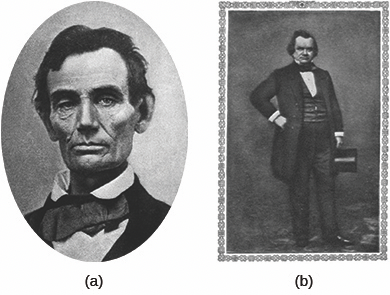
Douglas portrayed the Republican Party as an abolitionist effort—one that aimed to bring about miscegenationRace-mixing through sexual relations or marriage, or race-mixing through sexual relations or marriage. The “black Republicans,” Douglas declared, posed a dangerous threat to the Constitution. Indeed, because Lincoln declared the nation could not survive if the slave state–free state division continued, Douglas claimed the Republicans aimed to destroy what the founders had created.
For his part, Lincoln said: “A house divided against itself cannot stand. I believe this government cannot endure permanently half Slave and half Free. I do not expect the Union to be dissolved—I do not expect the house to fall—but I do expect it will cease to be divided. It will become all one thing, or all the other. Either the opponents of slavery will arrest the further spread of it, and place it where the public mind shall rest in the belief that it is in the course of ultimate extinction: or its advocates will push it forward till it shall became alike lawful in all the States—old as well as new, North as well as South.” Lincoln interpreted the Dred Scott decision and the Kansas-Nebraska Act as efforts to nationalize slavery: that is, to make it legal everywhere from New England to the Midwest and beyond.
During the debates, Lincoln demanded that Douglas explain whether or not he believed that the 1857 Supreme Court decision in the Dred Scott case trumped the right of a majority to prevent the expansion of slavery under the principle of popular sovereignty. Douglas responded to Lincoln during the second debate at Freeport, Illinois. In what became known as the Freeport DoctrineA doctrine that emerged during the Lincoln-Douglas debates in which Douglas reaffirmed his commitment to popular sovereignty, including the right to halt the spread of slavery, despite the 1857 Dred Scott decision affirming slaveholders' right to bring their property wherever they wished, Douglas adamantly upheld popular sovereignty, declaring: “It matters not what way the Supreme Court may hereafter decide as to the abstract question whether slavery may or may not go into a territory under the Constitution, the people have the lawful means to introduce it or exclude it as they please.” The Freeport Doctrine antagonized southerners who supported slavery, and caused a major rift in the Democratic Party. The doctrine did help Douglas in Illinois, however, where most voters opposed the further expansion of slavery. The Illinois legislature selected Douglas over Lincoln for the senate, but the debates had the effect of launching Lincoln into the national spotlight. Lincoln had argued that slavery was morally wrong, even as he accepted the racism inherent in slavery. He warned that Douglas and the Democrats would nationalize slavery through the policy of popular sovereignty. Though Douglas had survived the senate election challenge from Lincoln, his Freeport Doctrine damaged the political support he needed from the Southern Democrats. This helped him to lose the following presidential election, undermining the Democratic Party as a national force.