19. The Growing Pains of Urbanization, 1870-1900
Change Reflected in Thought and Writing
In the late nineteenth century, Americans were living in a world characterized by rapid change. Western expansion, dramatic new technologies, and the rise of big business drastically influenced society in a matter of a few decades. For those living in the fast-growing urban areas, the pace of change was even faster and harder to ignore. One result of this time of transformation was the emergence of a series of notable authors, who, whether writing fiction or nonfiction, offered a lens through which to better understand the shifts in American society.
UNDERSTANDING SOCIAL PROGRESS#
One key idea of the nineteenth century that moved from the realm of science to the murkier ground of social and economic success was Charles Darwin’s theory of evolution. Darwin was a British naturalist who, in his 1859 work On the Origin of Species, made the case that species develop and evolve through natural selection, not through divine intervention. The idea quickly drew fire from the Anglican Church (although a liberal branch of Anglicans embraced the notion of natural selection being part of God’s plan) and later from many others, both in England and abroad, who felt that the theory directly contradicted the role of God in the earth’s creation. Although biologists, botanists, and most of the scientific establishment widely accepted the theory of evolution at the time of Darwin’s publication, which they felt synthesized much of the previous work in the field, the theory remained controversial in the public realm for decades.
Political philosopher Herbert Spencer took Darwin’s theory of evolution further, coining the actual phrase “survival of the fittest,” and later helping to popularize the phrase social Darwinism to posit that society evolved much like a natural organism, wherein some individuals will succeed due to racially and ethnically inherent traits, and their ability to adapt. This model allowed that a collection of traits and skills, which could include intelligence, inherited wealth, and so on, mixed with the ability to adapt, would let all Americans rise or fall of their own accord, so long as the road to success was accessible to all. William Graham Sumner, a sociologist at Yale, became the most vocal proponent of social Darwinism. Not surprisingly, this ideology, which Darwin himself would have rejected as a gross misreading of his scientific discoveries, drew great praise from those who made their wealth at this time. They saw their success as proof of biological fitness, although critics of this theory were quick to point out that those who did not succeed often did not have the same opportunities or equal playing field that the ideology of social Darwinism purported. Eventually, the concept fell into disrepute in the 1930s and 1940s, as eugenicists began to utilize it in conjunction with their racial theories of genetic superiority.
Other thinkers of the day took Charles Darwin’s theories in a more nuanced direction, focusing on different theories of realisma collection of theories and ideas that sought to understand the underlying changes in the United States during the late nineteenth century that sought to understand the truth underlying the changes in the United States. These thinkers believed that ideas and social constructs must be proven to work before they could be accepted. Philosopher William James was one of the key proponents of the closely related concept of pragmatisma doctrine supported by philosopher William James, which held that Americans needed to experiment and find the truth behind underlying institutions, religions, and ideas in American life, rather than accepting them on faith, which held that Americans needed to experiment with different ideas and perspectives to find the truth about American society, rather than assuming that there was truth in old, previously accepted models. Only by tying ideas, thoughts, and statements to actual objects and occurrences could one begin to identify a coherent truth, according to James. His work strongly influenced the subsequent avant-garde and modernist movements in literature and art, especially in understanding the role of the observer, artist, or writer in shaping the society they attempted to observe. John Dewey built on the idea of pragmatism to create a theory of instrumentalisma theory promoted by John Dewey, who believed that education was key to the search for the truth about ideals and institutions, which advocated the use of education in the search for truth. Dewey believed that education, specifically observation and change through the scientific method, was the best tool by which to reform and improve American society as it continued to grow ever more complex. To that end, Dewey strongly encouraged educational reforms designed to create an informed American citizenry that could then form the basis for other, much-needed progressive reforms in society.
In addition to the new medium of photography, popularized by Riis, novelists and other artists also embraced realism in their work. They sought to portray vignettes from real life in their stories, partly in response to the more sentimental works of their predecessors. Visual artists such as George Bellows, Edward Hopper, and Robert Henri, among others, formed the Ashcan School of Art, which was interested primarily in depicting the urban lifestyle that was quickly gripping the United States at the turn of the century. Their works typically focused on working-class city life, including the slums and tenement houses, as well as working-class forms of leisure and entertainment (Figure 19.16).
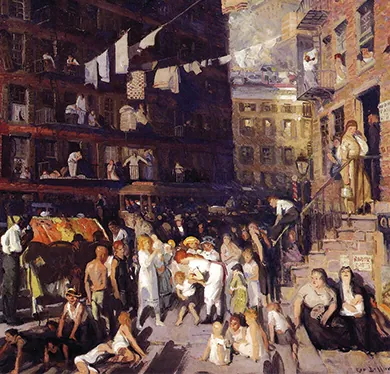
Figure 19.16 Like most examples of works by Ashcan artists, The Cliff Dwellers, by George Wesley Bellows, depicts the crowd of urban life realistically. (credit: Los Angeles County Museum of Art)
Novelists and journalists also popularized realism in literary works. Authors such as Stephen Crane, who wrote stark stories about life in the slums or during the Civil War, and Rebecca Harding Davis, who in 1861 published Life in the Iron Mills, embodied this popular style. Mark Twain also sought realism in his books, whether it was the reality of the pioneer spirit, seen in The Adventures of Huckleberry Finn, published in 1884, or the issue of corruption in The Gilded Age, co-authored with Charles Dudley Warner in 1873. The narratives and visual arts of these realists could nonetheless be highly stylized, crafted, and even fabricated, since their goal was the effective portrayal of social realities they thought required reform. Some authors, such as Jack London, who wrote The Call of the Wild, embraced a school of thought called naturalisma theory of realism that states that the laws of nature and the natural world were the only relevant laws governing humanity, which concluded that the laws of nature and the natural world were the only truly relevant laws governing humanity (Figure 19.17).
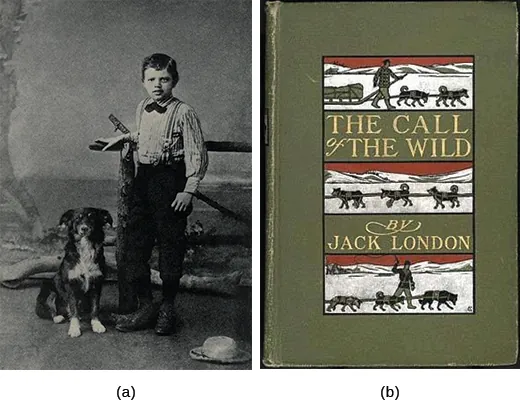
Figure 19.17 Jack London poses with his dog Rollo in 1885 (a). The cover of Jack London’s The Call of the Wild (b) shows the dogs in the brutal environment of the Klondike. The book tells the story of Buck, a dog living happily in California until he is sold to be a sled dog in Canada. There, he must survive harsh conditions and brutal behavior, but his innate animal nature takes over and he prevails. The story clarifies the struggle between humanity’s nature versus the nurturing forces of society.
Kate Chopin, widely regarded as the foremost woman short story writer and novelist of her day, sought to portray a realistic view of women’s lives in late nineteenth-century America, thus paving the way for more explicit feminist literature in generations to come. Although Chopin never described herself as a feminist per se, her reflective works on her experiences as a southern woman introduced a form of creative nonfiction that captured the struggles of women in the United States through their own individual experiences. She also was among the first authors to openly address the race issue of miscegenation. In her work Desiree’s Baby, Chopin specifically explores the Creole community of her native Louisiana in depths that exposed the reality of racism in a manner seldom seen in literature of the time.
African American poet, playwright, and novelist of the realist period, Paul Laurence Dunbar dealt with issues of race at a time when most reform-minded Americans preferred to focus on other issues. Through his combination of writing in both standard English and black dialect, Dunbar delighted readers with his rich portrayals of the successes and struggles associated with African American life. Although he initially struggled to find the patronage and financial support required to develop a full-time literary career, Dunbar’s subsequent professional relationship with literary critic and Atlantic Monthly editor William Dean Howells helped to firmly cement his literary credentials as the foremost African American writer of his generation. As with Chopin and Harding, Dunbar’s writing highlighted parts of the American experience that were not well understood by the dominant demographic of the country. In their work, these authors provided readers with insights into a world that was not necessarily familiar to them and also gave hidden communities—be it iron mill workers, southern women, or African American men—a sense of voice.
While a few contemporary reviewers saw merit in the book, most criticized it as immoral and unseemly. It was censored, called “pure poison,” and critics railed against Chopin herself. While Chopin wrote squarely in the tradition of realism that was popular at this time, her work covered ground that was considered “too real” for comfort. After the negative reception of the novel, Chopin retreated from public life and discontinued writing. She died five years after its publication. After her death, Chopin’s work was largely ignored, until scholars rediscovered it in the late twentieth century, and her books and stories came back into print. The Awakening in particular has been recognized as vital to the earliest edges of the modern feminist movement.